Welcome back, dear reader, to more stories for your enjoyment and amusement.
People often ask how I remember so many moments from my youth. I tell them I’ve been blessed (or cursed) with an above‑average memory. I can recall events from my pre‑ambulatory days — not everything, mind you, but enough to make people wonder if I was born with a built‑in surveillance system. My memory is nothing like actress Marilu Henner’s, who has hyperthymesia, also known as Highly Superior Autobiographical Memory (HSAM). People with HSAM can recall life events in extraordinary, calendar‑specific detail.
As for me, I remember blips and blurbs, little vignettes that stuck because something about the moment stood out — sometimes traumatic, usually humorous, and occasionally the sort of thing that makes you think, “Well, that explains a lot.”
My earliest memory is of my father changing my diaper. I couldn’t walk yet, and I doubt I was talking. I don’t remember any conversation on my part, but I do remember my dad making utterances I couldn’t understand. (Probably for the best. I suspect some of those utterances would have earned him a strongly worded letter from modern parenting blogs.)
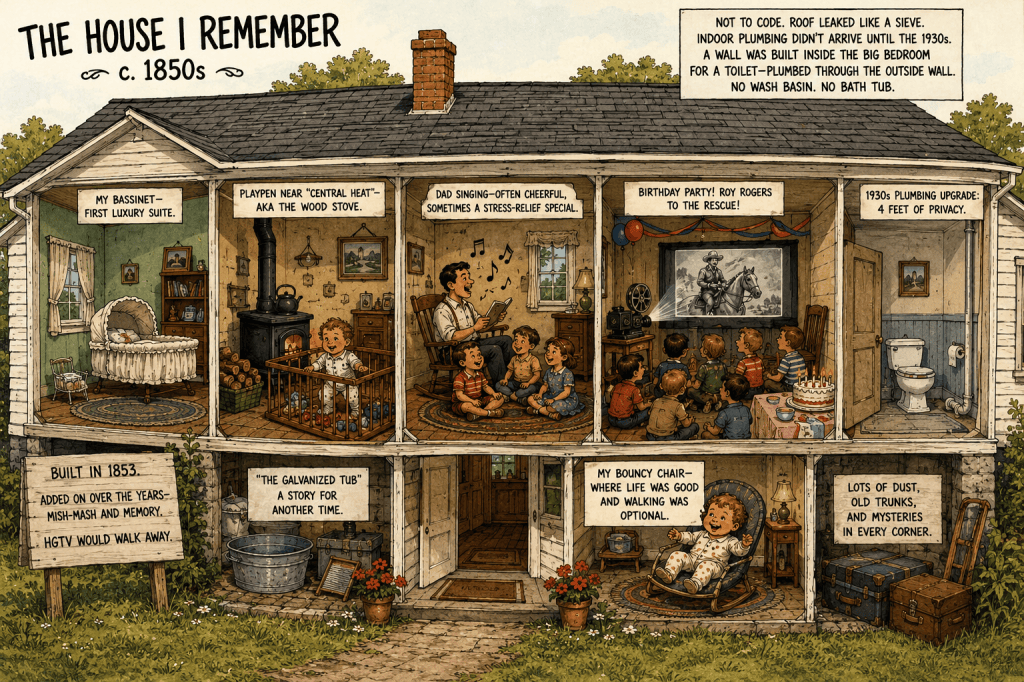
My memory begins in the first house I remember — a very old home, dating back to the 1850s. The original two‑room foundation was built in 1853. Over the decades, rooms were added in a mish‑mash fashion that somehow worked. It wasn’t to code, I’m sure, and the roof leaked like a sieve. Indoor plumbing didn’t arrive until the 1930s, and even then it was an afterthought: a wall built inside the largest bedroom to carve out four feet of space for a toilet plumbed straight through the outside wall. No wash basin, no bath tub. (“The Galvanized Tub” is a story for another time.)
If HGTV had shown up, they would’ve backed away slowly and said, “We don’t have a show for… whatever this is.”
I digress, but I wanted you to picture the house I was born into — a place where every room had a personality, and none of those personalities were friendly.
Back to the diaper change. I was in a wooden playpen — pre‑fifties vintage — the same one my older brother and sister both pre‑ambulated around in before it was my turn. The playpen sat next to our “central heat,” which was nothing more than a wood‑burning stove in the middle of the center room. No ducts, no vents — if you wanted heat, you kept your door open and prayed the stove didn’t have an attitude that day.
I was warm, playing with my toys, when my dad decided it was time to check the diaper. He picked me up gently and placed me on the bassinet. So far, so good. He opened the diaper pins, cleaned me, powdered me, and reached for the fresh diaper.
He was in a happy mood, singing and talking to me in a language I would eventually attempt to master. And just as he was about to pin the new diaper on, I giggled, cooed, and — with perfect comedic timing — unleashed a powerful spray. The look on his face went from cheerful to shocked in an instant. He did his best to deflect the stream aimed at his face and was mostly successful. Had I understood the words he said, I might have learned a few sailor terms long before my Navy days.

Back to square one. Fortunately for him, my bladder was empty the second time around. He finished the job with the weary determination of a man who had seen things.
Another early memory is the day of my first step. I was a slow walker, preferring my little bouncy chair where I could bob around the rooms like a tiny, happy jackhammer. When taken out and encouraged to walk, I’d plop down immediately with no interest whatsoever. Walking seemed like a lot of work for very little reward.
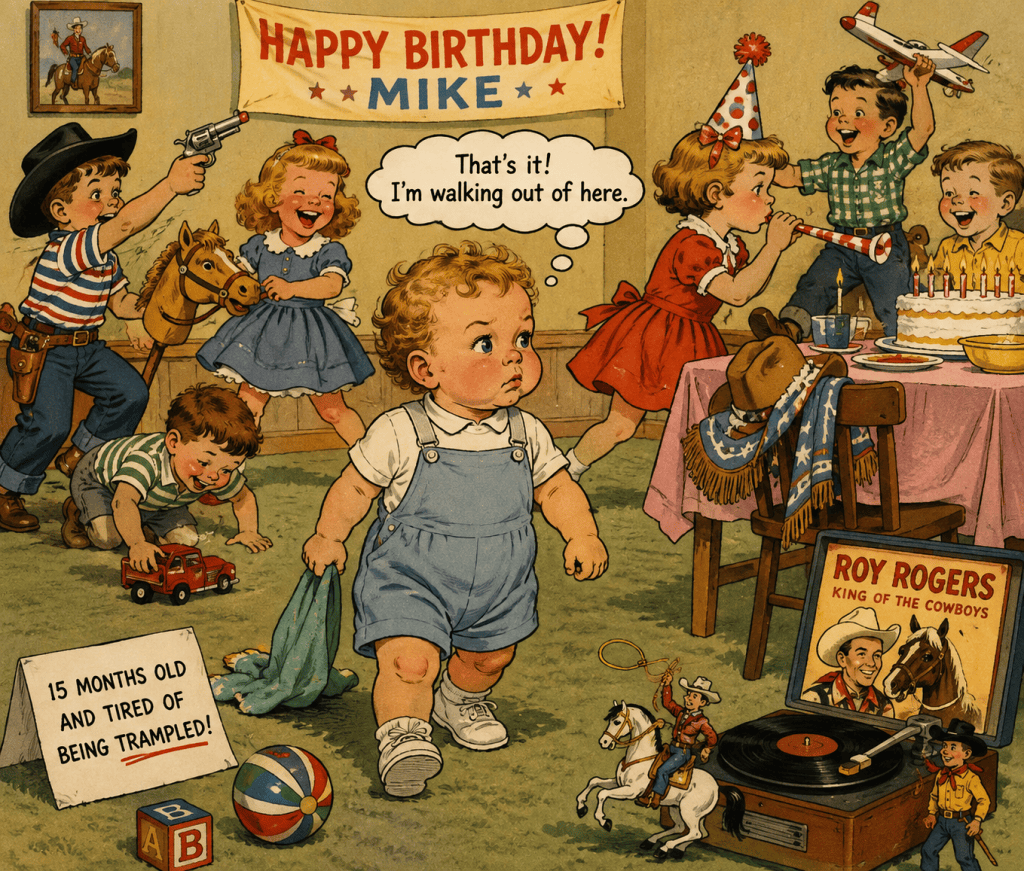
That changed in March of 1951. My brother and sister, Eddy and Patty, were born one year and two days apart, old enough for a joint birthday party — which meant many children. To keep the chaos down, my dad borrowed the neighbor’s movie projector and a Roy Rogers and Dale Evans film.
Being fifteen months old, I didn’t understand the movie. I crawled around looking for trouble. The kids were glued to the screen. During the chase scene, they cheered Roy on as he tried to save Dale. I kept crawling. Roy saved the day. The movie ended. Lights came on. Cake and ice cream were expected. All the kids jumped up at once with no regard for the crawling toddler beneath them.
My hands were stepped on, I was bumped and tossed around. Even at fifteen months, I was stubborn and tough. As my father later told my mother, it was as if I simply got tired of being walked on. I got up and walked out of the melee — no wobbly legs, no unsure steps. Just, “Get the heck out of my way, I’ve had enough.”
I never crawled again. Once I realized walking meant fewer footprints on my hands, I committed.
Once I found my feet, the world didn’t stand a chance. Walking wasn’t just a skill — it was a mission. Every doorway became an opportunity, every sibling a target to trail, and every open space a place I fully intended to invade. I went from cautious crawler to determined explorer overnight, and my family quickly learned that keeping up with me was now a full‑time job. If the front door was opened, I would plan my escape so I could play outdoors. I would follow my brother and sister down the street to their friend’s house and show up unannounced just so I could play with them, which only made me a nuisance again.
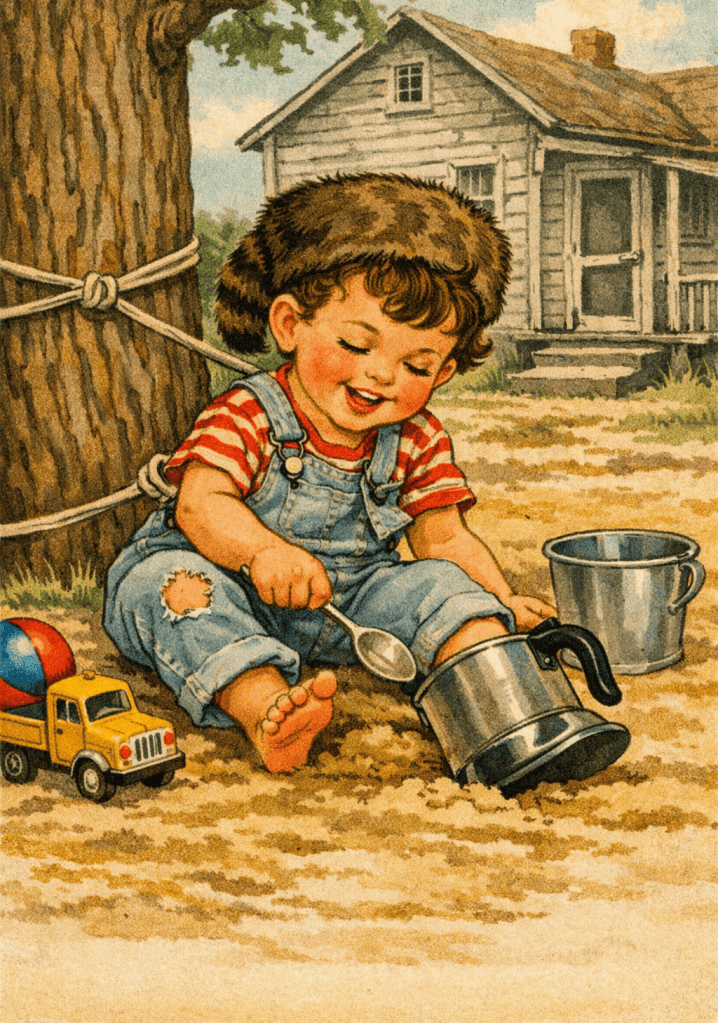
My mother was tired of chasing me around day after day, so she came up with a plausible plan that was typical for the parenting norms of the early 1950s, but wouldn’t pass the mustard in today’s climate. She got a long piece of clothesline rope, tied one end around the tree in our front yard, and — measuring out the rope so it would not reach the roadway — tied the other end around my waist. She gave me two items to play with: an old percolator coffee pot (not many of my younger readers will even know what this is) and an old tablespoon. Both items came in handy as I would sit under the tree, in our grassless yard, and play for hours in the sandbox that was our front yard.
I was born in Marquette, Michigan, and played in the dirt as a little child. My memory seems to be that the soil in our front yard was more sand than earth — the kind that puffed up in little clouds around my feet and stuck to my hands like flour. It wasn’t much of a yard, but to me it was a whole world: a place to dig, imagine, and make sense of things long before I understood anything about the bigger world beyond our street.
The dirt, as I remember it, came in layers. The top was ordinary, everyday sand — the kind that blew around my ankles and sifted through my fingers. Beneath that was a yellowish, damper band of compacted sand that held together better, almost claylike to my young eyes. And at the bottom sat a dark, nearly black layer, dense and cool, the kind of soil that felt ancient. As a very young child, I didn’t just look at these layers — I investigated them the only way toddlers truly understand anything: sight test, feel test, and finally the taste test. And yes, I tasted every level I dug into. Being tied to a tree didn’t leave me many entertainment options, so my days became a cycle of dig, taste, dig more, taste more, and dig again. It was my own little geological buffet, served up in the front yard of our Marquette home.
My mother was content, as she could see me from the front window. She didn’t think the dirt would hurt me — probably because my older brother and sister had tested it out before me and survived. I could be found, tied to the tree, playing in the sand and keeping busy with my two toys, the spoon and the metal percolator coffee pot, almost every day. That is, until the demise of the coffee pot.
The metal pot had years of scratches and dents on it, as I believe it served two or three decades on the railroads. My dad, who was working on the railroad at this time, brought it home after the railroad group he was on chipped in for a new one. I played with it for months, packing layers of tasty dirt into it and pouring it out. (I was easily amused at that age.)
One day, for whatever reason, I decided to see if I could do something more with it — my imagination was spreading out. I wondered what kind of shoe the pot would make. Without planning at all, I slipped my foot into the pot. Ahh, it fit! Then I tried to stand up and walk. No way. It was stuck. I tried tugging and kicking it with my other foot, but nothing worked.
Now here I was, foot stuck in the pot and no way to walk around. What do I do? Figure out a better plan? Of course not. The end‑all and be‑all for a small child: I cried for my MOMMIE!!!
Mom came running out of the house as if a scavenging eagle had swooped down and was trying to carry me away. When she saw my plight, the look on her face turned from panic to one of wonder, as if she was thinking, “What the heck did he do now?” She tried to gently tug at the coffee pot at first. No luck. Then tugging harder. No chance. Finally she was pulling with all her might and I was crying. I thought by then my leg was six inches longer than the other.
With no success of her own, she noticed our neighbor, Al King, was home. Al was a very nice retired man who would look out at me during the days and watch me busy myself at the end of my rope. He was a retired engineer and an all‑around handyman if anyone in the neighborhood needed something done. My mother picked me up, and off to Al’s house we went.
Until then, I had never been inside Al’s house, but I was fascinated by what I saw. It was quite different from ours. First of all, there were no kids’ toys scattered all over, as his two daughters had already grown. He had an upright piano next to the wall that fascinated me. I had only seen toy pianos and never a real one before.
I was drawn to the piano as if by some magical magnet. I hobbled right up to it as Al hadn’t even had time to look at my coffee‑potted foot. I reeled in disgust. Right at the end of the piano, on top of the closed key covering, sat a pile of “dog‑dirt”! Oh my! Hadn’t he noticed some dog must have broken into his house and pooped on his fancy piano?? I lost my balance from surprise and down I went on my butt.
Mom and Al were both laughing at the hilarious sight I must have caused. I had no idea they saw it also, and didn’t want to say anything as I went over to examine it. Al went over to the piano, smiling, and picked it up with his bare hands! Yech!!! As I watched, he slowly brought the pile of poo down to my eye level. I finally found out what it really was. It turned out to be a ceramic ashtray.
After a few more laughs by Mom and Al, he swiftly — and very gently — twisted my foot a bit and off came the coffee pot. Mission accomplished. Mom thanked him, I thanked him as best as I could, and we were headed toward the door to go back home. Al stopped us, turned to me, pooped ashtray in hand, and said I could have it if I wanted. My response? “Ugh, NO,” as I turned my head away. I could eat dirt, but didn’t want anything to do with poop, real or imaginary!
Thank you for staying with me through these youthful memories. Going back to the beginning of this story, where I mentioned that people often ask how I remember so many moments from my early years—well, stories like this are exactly why.
These little flashes of comedy, chaos, and curiosity rise to the surface without warning, as vivid now as the day they happened. They’re not full chapters, just tap‑on‑the‑shoulder reminders of where I came from and how those early moments shaped me. I’m grateful you took the time to walk through this one with me, and I hope you’ll join me again as more of these memories step forward and ask to be told.
There are many more memories from my youth in the book I published last year, “You Can’t Get Blisters Treading the Waters of Life.” (Available on Amazon.) Come back on September 15, when I’ll begin sharing a few of those stories with you — including some that prove my childhood was equal parts comedy, chaos, and character‑building.


Leave a Reply