Boots, Crutches, and Karma
The sprain that hurt worse than a break, but turned misfortune into silver lining
Some stories you limp through, others you laugh through — this one gave me both.
One unlucky fall in Danang Harbor left me hobbling on crutches for over a month, battling Navy “logic,” and discovering just how cruel a sprain can be. But what began as pain and frustration became a turning point—a month of missteps, mishaps, and unexpected twists that changed the course of my service, and my life.
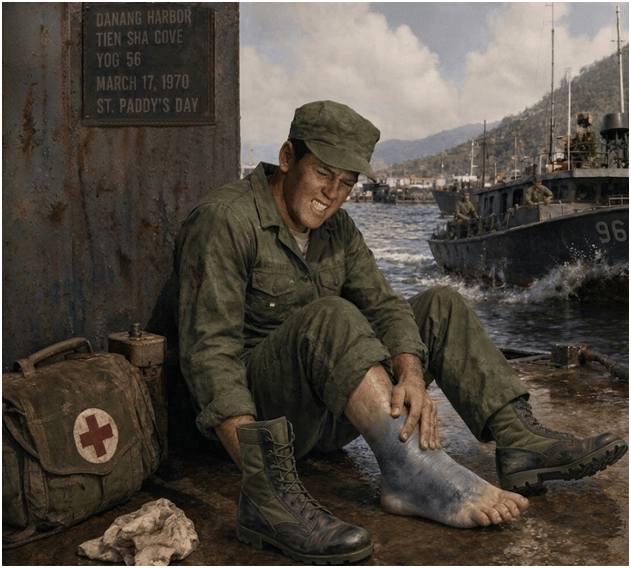
March 17th, 1970. St. Paddy’s Day. A Day that is supposed to bring luck to the Irish. Well, I found out, luck apparently took that day off in Vietnam.
I Corps, (pronounced “Eye Core”), South Vietnam, Danang Harbor, Tien Sha Cove, YOG 56, 14:35 hours, Catwalk.
“What the . . . ”
That was all I managed to get out before a “Mike” boat rammed into the side of our craft like it had a personal grudge against me. Down I went—onto the fuel lines, bouncing off the tank tops, and landing with a solid THUMP on the deck of our little fueling vessel. I couldn’t have executed that fall any worse if I’d practiced it, which I definitely hadn’t.
When I looked up, the Mike boat was already backing off as casually as a guy who bumps your car door in a parking lot and pretends he didn’t. Not a wave, not even the faintest “my bad.” Just off they went to spread more cheer somewhere else in the harbor.
My boat mates rushed over, forming a worried circle—faces hovering above me like anxious seagulls. For a beautiful moment, their concern was genuine. Then I opened my eyes. That’s when the razzing began. Sailors can flip from Florence Nightingale to Don Rickles in under five seconds.
“Oh, look—he lives!”
“Man, you sure know how to fall with style.”
“Three-point landing, shipmate. The Russians give it a 6.”
Then the real pain hit—sharp, deep, and serious—shooting up from my right ankle. Someone untied my jungle boot, which was thoughtful until he actually removed it. That’s when their expressions changed. These Vietnam-hardened swabbies suddenly turned green as pea soup. One even made a run for it.
I looked down—and understood why. My foot was ballooning like it was in the Macy’s Thanksgiving Parade. It was puffing up and blackening fast. Removing the boot was a mistake, but the damage was done. Boots hold everything together—even your dignity. To even attempt to but the boot back on would be like trying to squeeze toothpaste back into the tube.
Someone got on the Motorola ship-to-shore radio to call for transport. Thank goodness we were in Danang and not in the Cua Viet River just a couple clicks south of the DMZ, where we were most of the time, or I’d have been stuck waiting for a ride while my foot applied for statehood.
About twenty minutes later, a small harbor transport pulled up. Two of my buddies tried to help me aboard. Now, both men had good intentions, but neither had a plan. I was manhandled, hauled, tipped, and tilted like I was a crate of contraband someone wanted aboard without being seen. Every jostle sent my foot slamming into something solid, and each slam sent a fresh shockwave of misery all the way up to my eyebrows.
Transported over the rough waters of Tien Sha Cove towards the Lighterage docks where we were to wait for a jeep to arrive, every wave we hit was like a fiery explosion to my foot. Arriving at the dock, we had to manage the narrow, yet steep, causeway to the roadway, and then wait for the jeep. When it arrived, the driver, and my two buddies, ever helpful, hoisted me towards the seat, in a three man tug-of-war that tested their strength and vocabulary I tried not to grunt—they meant well, bless ’em—and besides, sailors don’t like showing pain unless it gets them out of undesirable duty.
Once in the jeep’s hard metal seat, I wedged myself in and braced for the ride. Five miles later, slightly rattled, possibly concussed, and with a foot three sizes larger than advertised, we arrived at the small dispensary.
The waiting area was packed with the usual assortment of Navy ailments—rash cases, mystery fevers, someone who probably swallowed something he shouldn’t have—but the moment the corpsman saw my foot, he waved me ahead with the urgency of a man who didn’t want that thing sitting anywhere near the general population.
I was ushered me into a tiny room containing one chair patched with surgical tape (naturally), a small cabinet, and an exam table that looked like it had fought in World War I and retired due to emotional damage.
I tried to hop onto it myself, but the attempt went about as well as you’d imagine. The shipmates were called back in to help hoist me onto the table—always graceful—and then they left for the benches outside, where they no doubt discussed the many ways I could have avoided this spectacle.
Left alone, I waited as my foot continued swelling like it was auditioning for a medical textbook illustration.
The doctor swept in and introduced himself. “Hello, I’m Lieutenant Collum and what seems to be—”
He stopped mid-sentence when he saw my foot. His eyebrows jumped.
“Never mind. Hold tight. I’ll be right back.”
And like that, he was gone. If he’d left a puff of smoke behind, it wouldn’t have surprised me.
About ten minutes later, in walked Corpsman Third Class Malone—young, confident, and looking like someone who still believed the Navy’s recruiting brochures.
“Let me see how bad it is, sailor.”
He squeezed my middle calf—because naturally, squeezing a swollen limb is step one in the Navy Medical Field Manual. My ankle was ballooned up to mid-calf by then. He wrapped it as tightly as he possibly could, handed me six chalky white pills that looked suspiciously like aspirin from a low-budget drugstore, and offered crutches that definitely weren’t adjusted for my height—or anyone’s height, really.
He scribbled a “Light-Duty Chit” like he was signing an autograph and sent me on my way with a breezy, “Come back in 30 days.”
Thirty? Days?
No X-rays? No doctor’s evaluation? No caution?
Just crutches, painkillers, and the hope I wouldn’t die on the way back.
Now I had to make my way back to my boat hobbling on crutches, which I had never used. I was with my two boat mates who, after we made our way to the military bus stop at the entrance to Camp Tien Sha, awkwardly helped me up onto the bus. Now, I wasn’t the smallest of figures getting into that bus, but once inside I found the aisle was too narrow to manage me and the crutches, so I carried them as I hobbled to the back where there was an empty seat.
When we arrived at the Lighterage dock, I got off the bus and made my way down a shaking ramp no larger than the bus aisle. I crept slowly and sideways because the ramp had no safety lines. It was open to the water below. If I lost my balance, I would have been dunked into the water of the cove.
Making it to the dock, my boat mates and I waited for the harbor transport to arrive, then shuffling onto the boat while it bobbed up and down from the waves, I thought of asking for a “Mae West”.
The transport came, rocking like a carnival ride. The 10 minute trip back was the same as the trip from the boat earlier.
Once back “home” at the 56, I had to balance my good left foot on the rail of the transport boat, throw my crutches up on the deck three feet above my waist, wait for the waves to hit just right, tumble chest first on to the deck, and shimmy the rest of my body on deck, all without missing a beat. If I messed up, I would have fallen between the side of the transport boat and the 56. Once safe on my own boat, I mentally declared a personal no-travel ban until my next medical appointment
I gave my Craftmaster the “Light-Duty Chit.” He gave it a look, chuckled, and tucked it into his pocket like a souvenir. We were already running short-handed, and “light duty” is Navy for “do everything you normally do but complain less.”
And so began my month on crutches—standing watch while sitting down, chipping paint from whatever position caused the least screaming in my ankle, and learning the fine art of navigating a boat whose surfaces all seemed designed to humiliate someone with limited mobility.
Getting down to the deck wasn’t so bad, I had gravity to help, but getting up was literally a pain! There was no way I could rise without bumping my foot one way or another and balancing with the crutches was a bitch for sure. The rubber grips on the bottom of each would slip and slide on the fine layer of oil mixed with the salt from the sea and I would be splayed out on deck, crutches flying left and right.
Getting into the actual living spaces of the boat was even worse that getting up off the deck outside. Every compartment had 15-inch coamings, which were obstacles meant to prevent water from going from compartment to another.
To get from one compartment to the next, I would plant the rubber tipped bottom of both of my crutches firmly on the other side of the coaming. I would then have to jump/swing over the coaming and plant my good foot solidly so I would not slip and crash onto the deck. As I write this, I can feel the sensation of the fruitless attempts, the panic of knowing the crutches did not hold, and the crash to the decks while once again, the crutches flew from my hands. As long as I used the crutches, I never was able to master the action of hopping over the coaming.
Every compartment had those dang 15-inch coamings. I approached them the way Olympic athletes approach hurdles, except they usually clear theirs. Half the time my crutches slipped, the other half I slipped, and on particularly lucky days, all of us slipped together.
Another action I had to attempt mastering was climbing the ladder from our main deck, to the forecastle, (commonly called the “fo’c’sil”, pronounced “Folk-sill”), on the bow or the aft’ deck at the stern of the boat.
I would toss my crutches up on those decks, and then hold on to the “grabrails”, (handrails), to jump step to step making my way. These ladders were much steeper than steps in a building as they were built to accommodate the confines of the small boat. I was, however, better at climbing the ladders than I was at moving from compartment to compartment.
One night up by the DMZ, the sea was rough. I was on night watch. I had to patrol stem to stern in the darkness, checking the sides of the boat for sappers, (enemy combat swimmers trained to infiltrate and attach explosives or attempt sabotage), not exactly an ideal task on one functioning foot.
Naturally, the catwalk was slick. Naturally, I fell. Both crutches shot over the side, down to the tank deck, like they were abandoning ship. I heard them thump when hitting the deck.
I lay there, momentarily defeated, then crawled along the grabrails until I reached the fo’c’sle. After catching my breath against the capstan,
Now, I was laying on the catwalk, momentarily defeated, crutches on the main deck. The boat bobbing up and down in the swells of the sea. I had to get my crutches, and finish my tour of the decks. The grabrails were helpful and I struggled as best I could, being a little disoriented at the time.
Making my way forward, I made it to the fo’c’sle. I leaned on the capstan, used to raise the anchor chain, to catch my breath. Then I crawled over to the ladder which went down to the tank deck. I butt-scooted down the ladder to the tank deck, crawled to the first crutch. With that one crutch, it was easier to hobble over to the second crutch. Success! I had made my trip around the boat, and back at the watch station so I could enter my trip into the log book . . . just in time do begin my trip all over again.
Crutches are humbling creatures.
Then came the night someone hid my crutches while I slept. When nature called, I had to hop my way to the head using the bulkheads as handrails. (It’s a good thing we were on a VERY small boat as it was only about 10 feet from my rack to the hatch.
At the hatch, however, I didn’t have my crutches to help leap over the coaming. Being desperate, I sat on the coming, grabbed the sides of the open hatch, and letting myself slide backwards as far as possible falling to the deck. I didn’t hurt, so with my good foot, I pushed off the coaming rolling onto my stomach. From there I crawled to the head to do my business like I was deploying for a secret mission.
The crutches were in the head, of course—where the culprit assumed I’d “eventually need them.” Navy logic at its finest.
Thirty-three days after my initial visit—because boats don’t follow medical schedules—we returned to Tien Sha Cove, and I made my way back to the dispensary. The nurse at the front desk kept glancing at me, then whispering to someone out of sight. Finally, she motioned for me to go into the same tiny exam room from a month earlier. She told me that Lieutenant Collum wanted to see me
The walls were thin enough to hear the muffled shouting outside: “But, but sir—”
“SHUT UP! I don’t want to hear any excuses!”
A door slammed, boots pounded, and in came Lieutenant Collum looking like a lobster that had just lost an argument. He asked, “How are you doing, young man?”
“Fine”, I replied, “much better than you look, err, with all due respect, sir!” Old habits die hard when addressing officers.
He chuckled, “Oh, I imagine you heard some of that, did you? Well, it actually concerned you. I want to apologize to you.”
“What for, I asked?” having no clue what was going on.
Surprising me, he responded, “You, young man, should have been lying in a nice clean bed in Yokosuka, Japan!”
I blinked. “What!!??!!??”
“Yes”, he continued. “I gave Corpsman Malone orders to call in for a med-evac that would take you to one of our ships seaside, heading to Yokosuka. There you’d have received proper care and a month of recovery. Malone ignored the order entirely and sent you back to your boat with crutches and aspirin instead. You had one of the worst sprains I ever came across. I was concerned you may end up with clotting and that could lead to all kinds of problems.”
I don’t know if it was a slip of the tongue or he meant to say it, but he topped off his explanation by saying, “That jerk of a Corpsman took it upon himself to disregard my orders and send you back to your boat.”
I told the Lieutenant a few of the highlights from my month of one-footed adventures. He went red again. I wisely spared him the full saga; I didn’t want to be responsible for his blood pressure.
“I will deal with him later, but since you are here now, let me see how things are going.” as he unwrapped my foot.
He unwrapped my foot, poked and prodded, and finally said it was healing, though slower than it should have. Then he added that the “Light-Duty Chit” should have been a “No-Duty Chit.” Of course, on our boat as undermanned as we were, that would have been about as useful as a screen door on a submarine.
“I will send you back to your boat. You should not have to use the crutches for much longer, in fact, if you are up to it, I will give you a cane. How is that?”
“Fine” I replied, as I was at the point I could begin to put pressure on my foot.
He offered me a cane and some more mystery pills, told me to be cautious in civilian life, and warned me that my ankle might remain weak forever. Bowling, he said, might be out of the question. With a 285 average before shipping off to ‘Nam, it was not exactly the uplifting prognosis I was hoping for.
“You shouldn’t need to come back again, unless you damage it again. Good Luck, young man.”
That was that. I left the crutches and took the cane add back to the boat I headed.
That all transpired between St. Paddy’s Day and mid April of 1970 and I never thought anything more of it until . . .
Flash forward to Cua Viet in early June, 1970. We were in the Cua Viet River refueling ammi barges for the redeployment of the 3rd Marine Division and elements of the 1st Marine Division from Northern I Corps (Quang Tri and Thua Thien provinces), as part of President Nixon’s Vietnamization strategy.
We had two ammi barges tied up on both our Port and Starboard sides and at least a dozen or so lined up behind them. Suddenly we heard a voice across the barges.
“You son-of-a-bitch! You there—you! I want to talk to you, you son-of –a-batch!!”
We all looked around, wondering who had angered the gods. Then we saw him. A soot-covered figure leaping from barge to barge like an angry, cussing gremlin. When he got close enough, he pointed straight at me.
“You! You!!” he stammered. “It IS you! YOU got me demoted and sent to this hell hole!”
It took a moment, but then I recognized him: Corpsman Malone.
Before he could say or do anything else, someone from his craft yelled for him to get the hell back where he belonged. Later, one of his shipmates filled me in. Malone was no longer HM3 Malone. He’d been busted two full ranks—a rare and impressive feat—and sent up near the DMZ to scrub bilges until further notice.
Karma had finally made port!
Epilogue
Sure, a month in Yokosuka in a clean bed would’ve been nice. But if I’d gone, I’d have been reassigned afterwards, stuck serving another fourteen months or more. Instead, once we trained a Vietnamese crew and turned over the 56 to them, I was eligible for an Early Out—anyone leaving Vietnam with less than 365 days remaining on their active duty could take it.
So the dark cloud did come with a silver lining. It just stepped on my foot first.
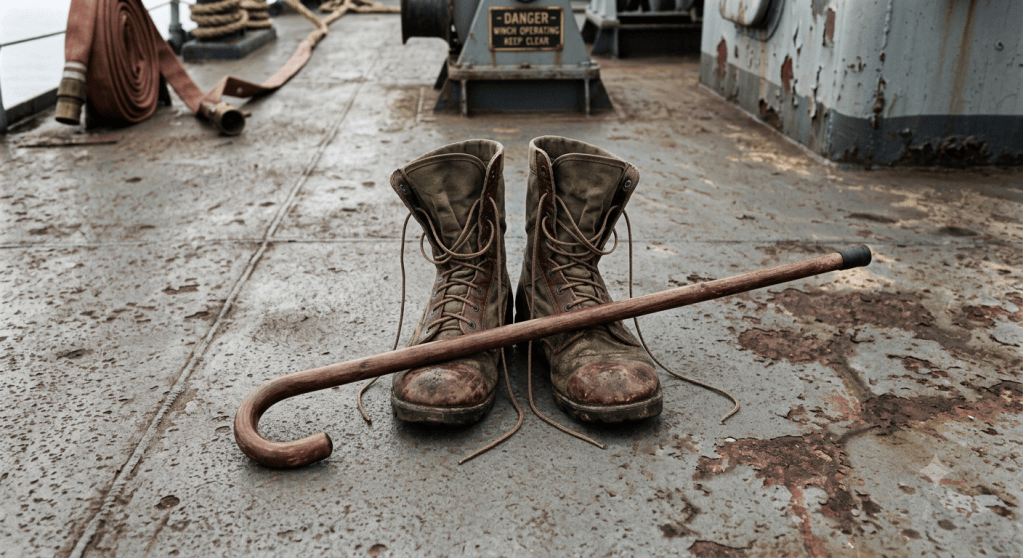
Pain taught the lesson. Perspective carried the rest.
✨ Thank you for walking (or hobbling) through this story with me. What began as pain became perspective, and what seemed like misfortune revealed its silver lining. Stories like these remind me that even the roughest steps can change our course for the better. If you enjoyed this tale, share it with a friend—because sometimes the best gifts are the ones we stumble into.
Make sure to come back in two weeks for more.


Leave a Reply