Welcome back dear readers:
Some stories from Vietnam stay sharp no matter how many years pass. This one comes from a night when the sea was angry, the sky was black, and a kid named Davy Masse’ reminded all of us that bravery doesn’t always look sane. Sometimes it looks like an 18-year-old diving into a storm just to prove a point. *Contains some adult language*
The night the sappers came for us, the South China Sea was boiling. September 9, 1969, aboard YOG 56, our little fuel carrier sat less than a mile off Cua Viet, rocking in the black waters. The wind howled through the rigging, salt spray stung my face, and the smell of fuel hung heavy in the air. This was the kind of night when even God stayed indoors.
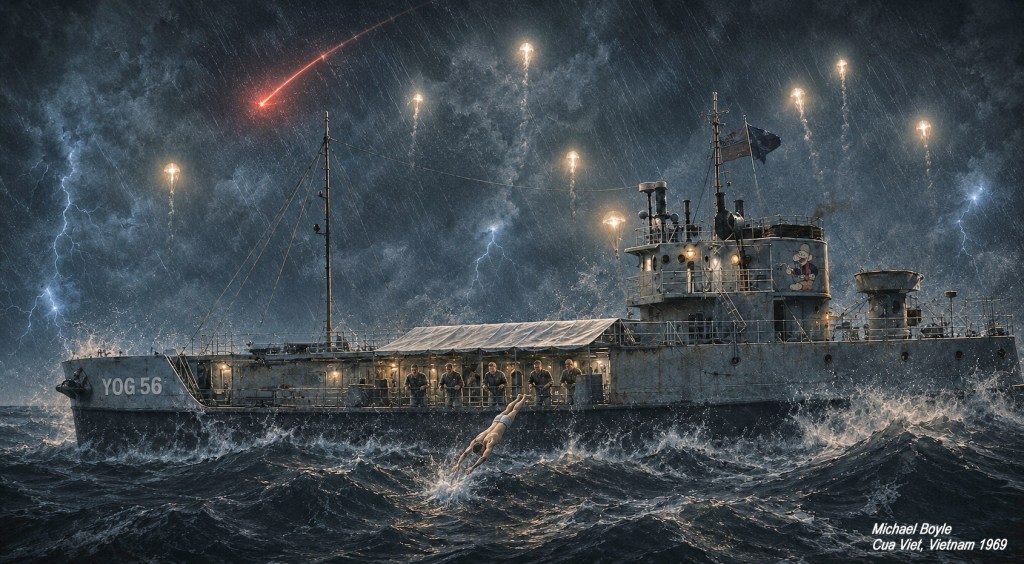
I was on the mid‑watch, scanning the waves for trouble.
Then I saw it — a shape, a head maybe, breaking the surface near our hull. My stomach clenched.
“All hands on deck! This is NOT a drill!” I bellowed, sprinting through the berthing area. “Sappers! SAPPERS!”
The crew jolted awake, boots thudding on steel decks, voices rising in confusion.
“What the hell’s going on?” someone shouted, tumbling out of his rack. “Did he say sappers? Jesus Christ…” another voice echoed as he grabbed his boots, but grabbed someone else’s boot in his haste.
I ran straight to the cabin of our Craftmaster, Chief Petty Officer Sean Kelly. Kelly was a lifer — twenty‑four years in, on his third Vietnam tour, and counting the days to retirement. His eyes snapped open at my words.
“You sure about this, Boyle?” he barked, already pulling on his shirt. “If this is a false alarm, I’m throwing him overboard myself.”
“I saw a head in the water, Chief. I swear it.”
Chief Kelly. who looked like a man who’d fought three wars and one bad marriage, cursed under his breath. “Goddamn it. If you’re right, we’re a floating firecracker.”
Back on deck, I yanked the pins on percussion grenades and hurled them into the water. The sea held its breath — then the night cracked open. The blasts echoed off the waves, sharp and hollow.
I fired white parachute flares into the sky, their hiss and crackle cutting through the storm. the flare lighting the deck like a ghost ship over the raging sea. Two or three others joined me.
Kelly grabbed the radio. “Cua Viet Base, this is YOG 56. YOG 56! Possible sappers in the water. Request immediate assistance.”
The reply came back, flat and dismissive: “Negative, YOG 56. The South China Sea is a raging tempest. No one would be stupid enough to swim out on a night like this.”
Kelly slamming the handset down so hard the casing cracked, he screamed, “Listen, you bastards — we’re sitting on fuel. If you’re wrong, we’ll light up half the goddamn coastline! Apparently the enemy had checked the weather report and decided to stay home!”
Chief Kelly looked at me and handing the broken handset to me he blurted out in disgust, “We’ll need a new radio after this — assuming we survive!”
After an hour of pleading, and a call up the chain to Danang, divers were finally dispatched.
It took ninety minutes of fighting through the waves before anyone arrived. By that time we had nearly depleted our supply of percussion grenades and white, parachute flares.
Arriving in a U.S. Navy Motor Whaleboat (MWB) — the standard utility craft carried aboard larger ships and used to shuttle sailors ashore. About 26 feet long, powered by a small diesel engine, the MWB could carry a dozen men at a time, but in seas like this it looked fragile, bobbing like a cork.
They couldn’t tie up alongside us; the waves would have battered them against our hull. Instead, they nosed in close, dropped the divers, and backed off to wait about a hundred yards away, riding the storm, all the while like a drunken duck.
The divers barely glanced over the side. One of them, looking bored, annoyed, and half asleep, shrugged. “No worries here. Nobody’s dumb enough to swim in this shit.” His partner, looking like a lifeguard who had been woken from a nap, chuckled. “You boys are jumpy. Waking us up for nothing.”
Kelly’s jaw tightened. His voice cracked with fury. “You think this is a joke? We’re sitting on three hundred thousand gallons of fuel. If you’re wrong, we’ll be vapor before sunrise. Get your asses in the water!”
That’s when Davy Masse’, our youngest crewman at 18, stormed onto the deck in his skivvies. Looking like a half-dressed lunatic auditioning for a Navy calendar, eyes wide and arms flailing, huffing and puffing, he said nothing. When I first met him, he told me is parents had signed him in at 17, hoping the Navy would settle him down. It hadn’t. We all thought he was a little “teched.”
Ripping off his T‑shirt, his voice loudly cut through the noise of the raging storm: “Fuck ya’ll! I’ll show you what kind of water this is!”
Before anyone could stop him, he dove headfirst over the port side and into the black, raging sea.
“Jesus Christ, he’s gone!” someone shouted, panic rising. “Throw a line! Get a light over there!” another yelled, voice breaking.
Half of us gasped. The other half prayed. Two endless minutes passed. My heart pounded so hard I thought it might burst. Then, from behind us, from the other side of the deck, a voice cut through the storm: “Hey Motherfuckers! NOW tell me nobody can survive this damned water!”
We spun around. Davy, having swum under the boat, resurfaced on the starboard side, popping up like a deranged dolphin and grinning like a lunatic, salt water streaming down his face. If insanity were a medal, he’d have earned it right there.
The divers froze, shame written all over them. One muttered, barely audible: “Son of a bitch… kid’s crazy.”
Shamed, they finally geared up with the enthusiasm of men heading to the dentist and dove in the tempest churning in the sea. For forty‑five minutes they searched stem to stern, starboard to port. The sea swallowed them, and then spat them back up, their flashlights flickering under the waves.
When they surfaced, one of them muttered, “All clear. Sorry for the… misunderstanding.” Kelly folded his arms. “Next time, don’t call my men babies.”
We wrapped Davy in a blanket, warming him like the hero he was. His teeth chattered, but his grin was wide.
“Davy,” I asked, still shaking my head, “how the hell did you swim like that?” He smirked. “Florida State champ, ’66. Swimming and diving. Didn’t think I’d need it out here, but guess I was wrong.”
Three days later, a PBR patrol from Cua Viet found two dead sappers floating near shore. They were loaded with satchel charges of Composition C (C‑3 and C‑4) — enough to obliterate us. Based on their injuries, it was likely the percussion grenades I had thrown had stopped them.
Kelly looked at me quietly. He didn’t say much. He didn’t have to, just, “You were right, Boyle. Damn right.”
We realized then: we hadn’t been paranoid. We had been their target. We were almost dead!
Epilogue
On December 1, 1969, the Armed Forces Radio Network broadcast the first draft lottery in decades. We gathered in the mess, the smell of coffee and diesel in the air, listening intently.
The announcer’s voice droned on: “Draft number 335… March 14.”
Davy shot to his feet. “That’s me! March 14! Goddamn it, I never should’ve been here!” He ripped off his shirt again, bolted topside, and dove into the sea.
“Not again!” someone shouted. “Get him back before he swims to Saigon!” Kelly barked. He looked like he aged ten years in ten seconds!
Davy swam nearly half a mile before regaining his senses. When he returned, dripping and grinning, he explained: “That’s my birthday. If I’d stayed home, I never would’ve been drafted at all.”
I sympathized silently. My own number was even higher: 343.
That night on YOG 56, we learned three things:
- The danger was real, even when others dismissed it.
- War reminds you how thin the threads of fate really are.
- Sometimes it takes a “crazy” kid to prove the truth.
And that’s why we still remember Crazy Davy Masse’.
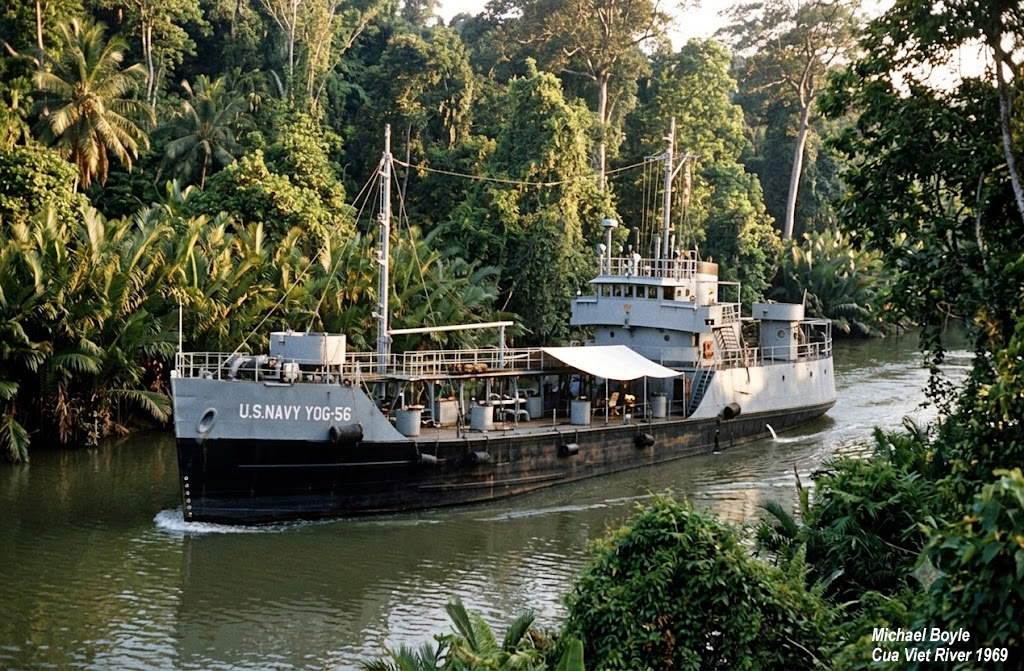
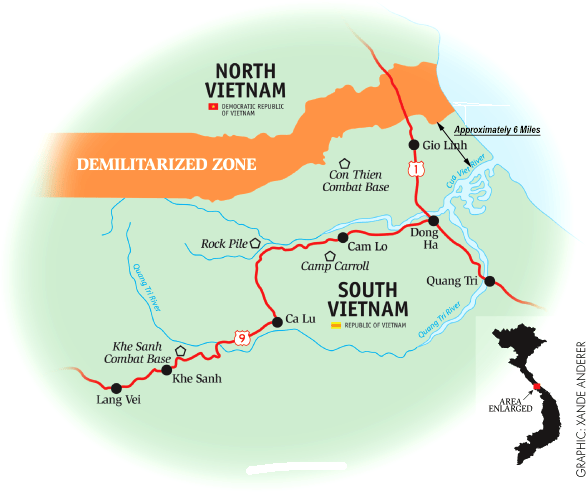
YOG‑56 heads up the Cửa Việt River toward the Dong Ha Combat Base, just six miles below the DMZ.
Every trip upriver meant pushing this 117‑foot fuel carrier through one of the most contested corridors in I Corps — well within range of NVA artillery, rockets, and hidden riverbank ambushes. Even on calm water, our crew stayed sharp, eyes scanning the jungle and sky, knowing that a quiet moment on the Cua Viet could turn dangerous without warning.
Because YOG‑56 was a fueling craft, carrying over 50,000 gallons of diesel, “mo‑gas,” or even volatile aviation fuel, we were prohibited from carrying meaningful armament. Our entire defensive arsenal consisted of one .45‑caliber handgun, one M‑16 rifle, and a flare gun loaded only with red flares — to be fired in the event of enemy attack.
Dear Readers, I hope this tale gave you a grin, a shiver, or at least a “you’ve got to be kidding me.” It all happened exactly as written.
Come back next time for another true Vietnam story — this one involving boots, crutches, and karma with a sense of humor. And if you enjoyed this entry, please share it and send your friends to theboyleblogs for more stories that are worth the read.
War is full of danger, but it’s also full of characters — the kind you never forget. Davy Masse’ was one of them. Wild, fearless, half-crazy, and somehow always right when it mattered. On that night in 1969, he didn’t just prove the sea could be survived. He proved that sometimes the bravest man on the boat is the one everyone thinks is nuts.


Leave a Reply