Author’s Note:
Welcome to this week’s blog post. Thank you for joining me today. I appreciate you as a valued subscriber.
Some stories stay with us because they touched something tender; others because they tested our patience, our sanity, or our ability not to scream in public. This week’s pair of tales lives on opposite ends of that spectrum—one about loyalty and loss, the other about surviving a stranger’s unstoppable monologue. Together they remind us that life is never just one thing. It’s grief and laughter, memory and absurdity, all tangled together.
Before we get to the humor, we begin with a story close to the heart. The Dog That Mooed is a tribute to a companion whose presence shaped a family’s days, routines, and quiet moments. It’s about devotion, friendship, and the strange little quirks—like a Dalmatian who mooed—that become the threads of a life shared. This is a piece about love, loss, and the echo a good dog leaves behind.
The Dog That Mooed

She came into our lives in April 1986. She just barely fit into my hand. With the exception of three spots on her snout, this Dalmatian puppy was pure white. She was lively and loveable and my wife fell in love with her from the beginning. Her name was to be Blaze.
We weren’t sure about letting Blaze sleep in the house the first night she was with us, so we put her in a box in the garage. Blaze didn’t take to that at all. She wanted to be with people. She whined and cried all night long. A Dalmatian puppy cries are much like a human baby cry. Needless to say, she was given the chance to stay indoors the second night.
We were leery about having her in the house since, as a puppy, she wasn’t house broken, (or so we thought). That first night, Blaze climbed into bed with us, curled up at our feet, and slept through the night. She never did have to be house broken. From then on, she was an indoor dog and loved it.
It was Kelli, our youngest daughter that found out about the “moo”. Blaze wasn’t much more than a few months old and Kelli was on the floor playing with her, rubbing her underbelly. She pressed a bit too much and out came the first moo from air being forced out of Blaze’s lungs. From then on, every chance Kelli got, she played Blaze like a bagpipe. Blaze loved it.
As Blaze got older, she would moo by herself. Usually it was when she lay down to rest. After circling her bed four or five times and finally settling down, she would take a deep breath and let out a long, loud, “moooooooooooooo.” It was then and only then that we knew she was finally settled for the time being
We had another dog at the time; a collie named Sheba. Sheba was seven years old at the time and was our outdoor dog. Blaze and Sheba hit it off great. Sheba’s motherly instincts took over any time she was around Blaze. She tolerated Blaze’s playfulness with remarkable patience. Blaze would run circles around Sheba and tug at her mane and tail as if to say, “Play with me, play with me.”
As the years went on, Sheba and Blaze became inseparable. If we took them to be groomed and Sheba disappeared around the corner to be bathed, Blaze would put up such a fuss that the groomers would have to move Blaze so she could easily see Sheba. Only then would Blaze settle down.
Maggie and I were going to a wedding out of town for a weekend; it would be the first time we had to put the dogs put into a kennel. Both dogs were fine when we dropped them off. When we returned two days later to pick them up the receptionist said, “They don’t like to be separated, do they?” She explained that as soon as we left and the dogs were put into separate kennels, Blaze started whining and fussing.
Even though the dogs were in kennel cages next to each other, that wasn’t good enough for Blaze. She continued to whine, bark, and fuss. She then began to claw and bite at the cage to the point where the attendant believed she would hurt herself. Finally, out of frustration or exacerbation, and even though the kennel cage was only supposed to hold one dog, the attendant put Blaze in with Sheba. Blaze was instantly silenced. Her tail helicoptered, the kennel floor clacking under her nails until she could curl into Sheba’s mane.
The same experience was had at the veterinarian’s office. We would have Blaze go into the examining room first. If she didn’t, she would whine, fuss, and bark after Sheba was led away and she wouldn’t settle down until Sheba was brought back out for her to see.
The only two times the two dogs were separated for any long period of time was when we moved to and from Wisconsin. When we first moved from California to Wisconsin Blaze was too confused to know what was going on.
We drove across country and left old lady Sheba in California with Kelli, our daughter, who was going to fly out three weeks later. The long drive would be too much for Sheba, who was already nine years old. We would ship Sheba on the same flight with Kelli. Blaze was kept busy being stuck in the back seat of our Suburban and had little time to think of Sheba. She handled the trip exceptionally well.
The second time, when we moved back to California, Maggie and I flew to California to look at houses in May of 2003. We left Blaze back in Wisconsin with Kelli while Sheba flew out with us and stayed at my mother-in-law’s house while we went back to Wisconsin and packed for the move. From the time we left the house to catch our plane for the quick round trip to California, Blaze was lost.
We talked to Kelli over the weekend. She said that upon her return to the house after dropping us off at the airport, Blaze met her at the door, looked around the garage for Sheba, and then ran around the house looking for her. Blaze wouldn’t eat, wouldn’t drink, wouldn’t go outside by herself, and wouldn’t play. She moped around the house all weekend.
Maggie and I returned on Monday, leaving Sheba in California. Upon our arrival home, Blaze ran past us and into the garage looking for Sheba. When she didn’t see her there, she was visibly upset. It took her almost a week before she would eat much food or drink much water. The rest of the time we were in Wisconsin, Blaze would not want to go outside to relieve herself, let alone play. She had lost her best friend and she was deeply affected by her loss.
We made the mistake of mentioning Sheba’s name one time in front of Blaze. Her ears snapped up, her head swiveled from side-to-side, and then she jumped up and began pacing through the house looking for her buddy. We never made that mistake again.
In mid July we left Wisconsin for California and once again, Blaze was an excellent travel companion for Maggie. Upon reaching our new home and unloading the vans we went to my mother-in-law’s house, got Sheba, brought her to our new home, and reunited the dogs. Blaze couldn’t be happier. She sniffed and sniffed, ran circles around Sheba, smothered her with “doggie kisses” and wanted to play immediately. She was happy again.
Ever playful, ever faithful, we didn’t look forward to the day we would have to put Sheba down knowing how sad Blaze would be to have her best friend gone forever. Little did we know that Blaze would be the first to go. Early on the morning of February 15, 2004 I heard a quiet moo from Blaze. It was not her normal, “I am really relaxed” moo, but a long, drawn out, rather strange moo. Maggie heard it too. We also heard Blaze relieving herself on her doggie bed. She had never done that.
We got up and turned on the light. Blaze was curled up on her bed. Her head was bent gently and I could see her eyes were open slightly. Maggie knelt down to pet Blaze’s head and when she didn’t move, I put my head on her side to listen for a heartbeat. It was then I knew that Blaze had left us.
The next few days were very rough on both of us. Blaze was part of our family for over eight years. Yes, she was a dog, but she was the ever loving, ever giving, puppy that never grew up.
When alone over the next couple days I would hear her bark, I would catch a glimpse of her out of the corner of my eye, but then I knew it was only my imagination. It was then, when I realized I was alone in the house that I would cry.
I knew Blaze meant the world to Maggie, but I never realized how much Blaze meant to me. I found myself sobbing with no one to console me. I lost a dear friend too.
The house is silent now, no midnight moo to say good-night.
Author’s Note:
After lingering in the soft ache of memory, it feels only fair to shift gears. Life doesn’t hand us emotions in tidy categories; it throws them at us in unpredictable order. So now, from a dog who mooed to a woman who never inhaled, we move from the tender to the downright ridiculous. Consider this your emotional palate cleanser.
If the first story is a quiet exhale, this one is a full‑throttle, oxygen‑defying sprint. The Woman Who Never Inhaled recounts an airport encounter with a human monologue machine—a woman whose ability to talk without pause could qualify as an Olympic event. It’s a comedic survival tale, proof that sometimes the only thing you can do is sit, nod, and pray for your boarding announcement.
Two hours in an airport. One empty seat. One woman who never inhaled. What followed was less a conversation than a verbal hostage situation — and my survival depended on sarcasm. This is the story of Sheila, the unstoppable monologue machine.
The Woman Who Never Inhaled
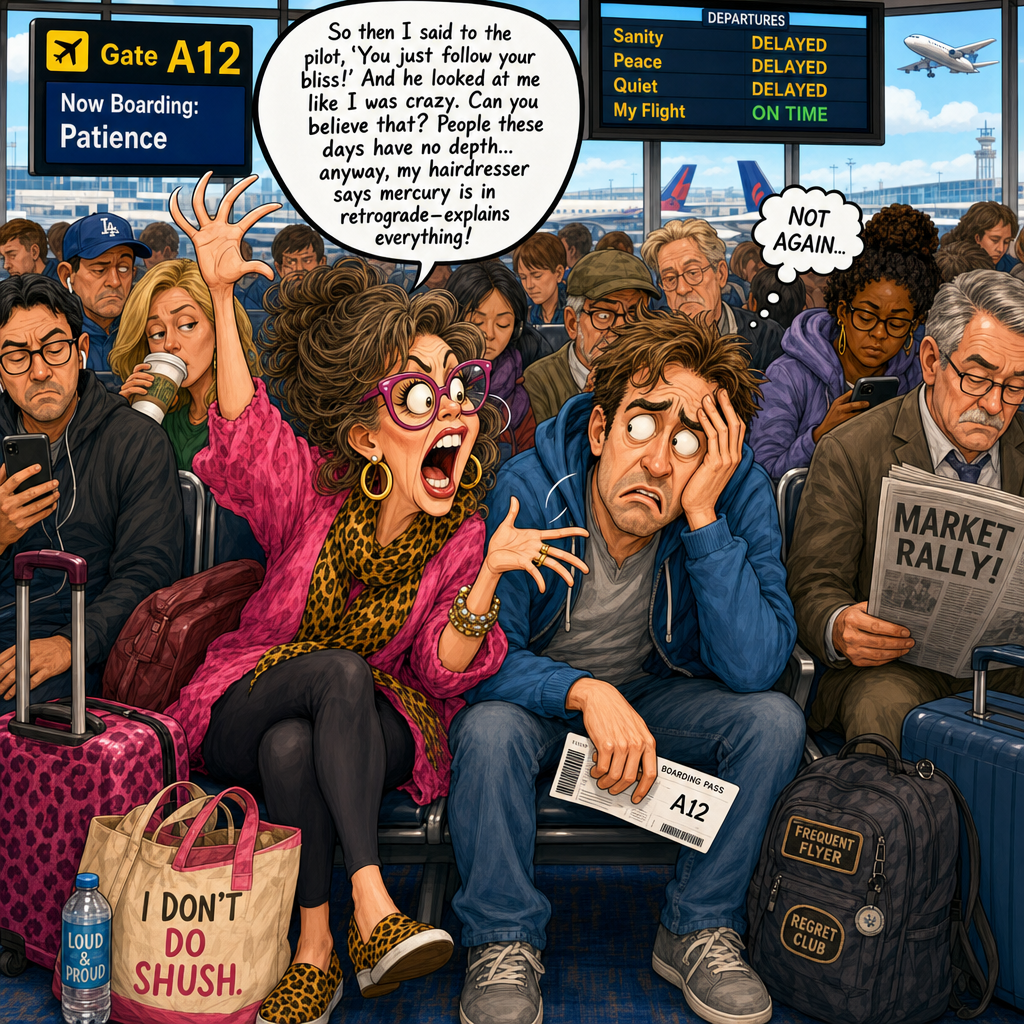
Even if I’d asked, she wouldn’t have heard me. Her mouth was a runaway train; my brain was tied to the tracks. She leapt from topic to topic like a caffeinated squirrel. My gray matter couldn’t keep up. She could recite the phone book and make it sound like a TED Talk. “God, woman, don’t you ever shut up?”
I wanted to scream it. Not whisper. Not mutter. Scream it—preferably through a megaphone while sprinting in the opposite direction. But alas, I was trapped beside a frumpy, middle‑aged chatterbox at Will Rogers International Airport in Oklahoma City. My punishment for running late? The only open seat was next to her. And I had two hours to kill. Two. Whole. Hours.
I didn’t sit down so much as surrender. From the moment my rear hit vinyl, I was hers. For over an hour, I endured her entire life story—delivered in one breathless, run‑on sentence that could have doubled as a hostage negotiation.
Her name was Sheila. She claimed to be 38. Sure she was. And I’m a 22‑year‑old Olympic gymnast. She looked 58, minimum. Red hair—clearly poured from a bottle labeled Sunset Fire Hazard. Divorced and remarried multiple times. Was it three? Four? I lost count somewhere between consciousness and coma. I assumed her husbands fled not from incompatibility, but from sheer vocal exhaustion.
She was born in Atlanta in 1950. (Quick math: that makes her 50 in 2001. So either she’s lying, or she discovered time travel and forgot to mention it.) She now lives in San Antonio—“San Antone,” as she put it, with a twang that made me question whether she’d ever actually been south of Cincinnati.
Highly educated, allegedly. Vassar? Brown? Maybe both. Perhaps she collected Ivy League diplomas like commemorative spoons. The longer she talked, the more her facts tangled like Christmas lights in a junk drawer.
Her job? Concession marketer. National Vice President, no less. Of what company? She never said. But according to her, it was one of the top three most prestigious concessionaire firms in the country. She was in Oklahoma City for a three‑day buying trip, then off to Chicago, St. Louis, Valencia, and every Six Flags in the continental U.S. “Don’t cha know.”
Yes, she said “Don’t cha know?” Repeatedly. Like a Midwestern parrot. I was dying to ask why someone born in Georgia and living in Texas sounded like she’d just stepped out of Fargo, but I didn’t dare interrupt. She might’ve started over from birth.
I’m convinced she breathes through gills. Hidden ones. Somewhere behind her ears. I never saw her inhale. Not once.
Sheila bragged about hiring a man in Orlando who was “extremely expensive.” To make room for him, she had to fire either a woman in Phoenix or a man in Seattle. Her method? She chose based on which city she preferred visiting. That’s right—she turned HR decisions into a travel itinerary. I got the distinct impression that firing people was her version of a spa day.
Her outfit was equally baffling. For someone allegedly running a multi‑million‑dollar operation, she dressed like she’d lost a bet. A black sack dress—shapeless, joyless—accessorized only by a bumblebee patch sewn onto the left rear. I stared at that bee for ten minutes, wondering if it was a cry for help.
Finally—mercifully—her boarding announcement came. I nearly wept. She wasn’t on my flight. Praise be. But did she stop talking? Of course not. She yammered all the way up the ramp to the jetway until a flight attendant intervened.
“Ma’am? Oh ma’am! You really must shut off your cell phone now!”
I wanted to hug that flight attendant. Or nominate her for sainthood.
Author’s Note:
Life gives us moments that break our hearts and moments that break our composure. Some memories return as a soft moo in the night; others as a stranger’s endless chatter echoing down a jetway. Both kinds of stories matter. Both shape us. Thanks for spending time with these two today—and for letting me share the laughter and the ache.
As always, please drop me a note if you like and share my blog with your friends. You are appreciated. Thank you.


Leave a Reply