Author’s Note –
Two weeks ago, I shared Part one of the story inspired by the poem I shared on March 3rd. Today, I’m posting the conclusion, but first, a recap:
Previously on Pot O’ Gold…
Young Seamus O’Donnell, desperate to save his family during the Great Hunger of 1847, set out across Arranmore Island in search of the Leprechaun King his grandmother once spoke of. Against all odds, he found King Brian by a brook, captured him, and demanded the traditional reward: a single pot of gold.
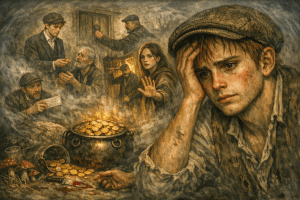
Brian kept his word. When Seamus returned home, the pot—overflowing with English sovereigns—was waiting by his cottage door. But the moment Seamus touched the gold, a terrifying vision overtook him: neighbors begging, the landlord raising rents, violence at the door, and the treasure bringing only misery and danger.
As the vision snapped away, King Brian watched him closely and said, “Ah… you saw it.”
Now for the conclusion of . . .
Pot O’ Gold
“What did I see?” My voice was rough.
“What gold does in times like these,” he said. “It buys, aye. And it burns.”
I took a half-step after him before I even knew what I was doing. “Wait—!”
King Brian paused and half-turned, one eyebrow cocked. “Eh? Something amiss, lad?”
I opened my mouth, then closed it. What was I going to say? My thoughts were muddled. I should have been overjoyed, running inside to wake Mam and celebrate. But instead I felt an odd hollowness stirring in my chest, as if the gleam of that gold had already dulled before my eyes.
“N-no, nothing amiss,” I stammered. “It’s just—”
He faced me fully again, hands clasped behind his back. His expression was unreadable now, ancient eyes studying me like a puzzle.
Words tumbled from my mouth unbidden, raw and honest: “It’s just that I thought I’d feel… happier.”
His head tilted slightly. “Oh?”
I swallowed hard. “All that gold—I mean, it’s everything I thought I wanted. Truly. Enough to save my family, maybe the whole village. And I am grateful. But now that it’s sitting there…” I struggled to explain the swirl of emotions in my heart: gratitude, yes, but also something like fear, and an unexpected emptiness. “Now that it’s sitting there, it feels… heavy.”
King Brian nodded slowly, as if unsurprised. He said nothing, giving me space to find the words.
I glanced back at the closed door behind me, picturing the pot in the gloom. “Heavy,” I repeated quietly. “And lonely.”
A breeze sighed through the heather along the lane. The king’s face softened; the mischief usually dancing in his eyes was tempered now by something gentler.
I took a step toward him. The words that came next rose from someplace deep inside me, deeper than hunger or desperation. “I don’t want to be ungrateful,” I said, voice trembling. “You’ve kept your word and given me what I asked for. But… but if you’d humor one last request, Your Majesty…”
He didn’t reply at once. His gaze flickered to my cottage, then back to me. “Another request, is it?” he said quietly. There wasn’t anger in his tone—more like wonder. “And what would that be, Seamus O’Donnell?”
I felt suddenly self-conscious. What was I asking? To give back the gold? To undo everything I’d fought for this day? It sounded absurd even in my own head. Yet my heart was guiding me now, sure as a lodestone.
I took a steadying breath. “Please,” I said, “take back your pot of gold.”
For a long moment, the only sounds were the distant crash of waves on the cliffs and the faint hiss of the breeze through the grass. King Brian’s eyes widened, then narrowed, as if uncertain he’d heard right. “Take it back?” he echoed.
My face grew hot. I plunged on, words tumbling faster now that I’d begun. “Yes. Take it back. I… I return my wish, I suppose. Or make a new one. However it works. I don’t want the gold.”
The King of the Leprechauns stared at me as though I’d just transformed into a fish and begun to waltz. “Boy,” he said slowly, “d’ye have any idea what ye’re saying? That pot holds enough wealth to drown ye in comfort. And after all ye did to get it—chasing me, squeezing me like a bellows—now ye say ye don’t want it?”
I nodded, a bit miserably. When he put it like that, I did sound like a fool. “I know it sounds mad. But it’s how I feel.”
King Brian stroked his beard, studying me intently. Perhaps he was searching for any sign I was playing a trick on him now. Finally, he spread his hands. “So be it, then. I keep me bargains. If ye truly wish me to take the gold away… I will. But I have to ask: why? Why in heaven’s name would ye give up such a prize won fair and square?”
That was the question, wasn’t it? Why? I had to sort it out in my own head even as he asked. I bit my lip and tried to put shape to the feelings roiling inside me.
“All my life,” I began slowly, “I thought nothing could be more precious than a pot of gold—especially now. But when I held it—just for that moment—I felt something was missing. The weight of it… it made me think of the weight my family already carries. The worry, the fear. Gold can buy food, yes, if there’s food to be found. It can pay rent—for a time. But it can’t bring back the dead, or heal the dying, or chase away loneliness.”
My voice caught. I hadn’t realized until I spoke that last word how true it was. Loneliness.
I swallowed and continued, each word unveiling a truth to myself as much as to him: “Gold is bright and shiny, sure, and it can buy many things. But its shine fades. If I took that gold, maybe we’d eat for a year or two… maybe not even, with so many mouths in the village. And then it would be gone, and what would remain? An empty pot and the memory that once I had something bright.”
King Brian listened quietly, his expression unreadable yet intent.
I went on, feeling tears prick at my eyes though I wasn’t quite sad. “While I was carrying you here—arguing and bargaining—I… I felt alive in a way I haven’t in ages. I haven’t wrestled or laughed or even talked with anyone outside my family for so long. Half the lads I used to play with are dead or have fled across the sea. I didn’t realize how starved I was for… for a friend.”
My cheeks burned, saying it so plainly, but the words kept flowing, gentler now: “Your gold, it’s grand, but if I kept it I’d be a rich stranger in my own village. Folks would beg or steal, and I’d have no friends left—only people who wanted what I had. The gold might even tear us apart; men have killed for less during these hard times. I think… I think I’d rather have something that lasts.”
“What gold does in times like these,” he said. “It buys, aye. And it burns.”
Finally, I looked King Brian in the eye. My voice was soft but sure. “What I truly wish for, more than anything, is your friendship. I’d like to be able to call you friend, and have you call me the same. That seems more faithful and true than any heap of coins.”
As my words settled in the cool air, King Brian’s face underwent a remarkable transformation. The guarded, cunning look he often wore fell away entirely. In its place was an expression of genuine astonishment, which slowly softened into warmth. His hazel eyes shone—not like gold, but like the deep green of the sea after a storm, bright with new sunlight.
“Ah, lad,” he said at length, and his voice was thick with emotion. “By my crown, ye’ve managed to surprise me utterly.” He gave a shaky chuckle. “And that’s no small feat—for I’ve been dealing with mortals and their greed since time out of mind. Not many would give back a treasure once in hand.”
He stepped forward and, to my surprise, reached up with both arms. I realized he was offering an embrace. I knelt instinctively, and King Brian wrapped his short arms around my shoulders as I put mine around his small frame. We hugged there in the middle of the lane—a ragged hungry boy and an ageless fairy king—as natural as kin. I felt a great weight lift off me.
“Friend, is it?” he murmured near my ear. “Ye’ve got a heart of pure gold yourself, Seamus O’Donnell.”
He pulled back and straightened his hat, composing himself with a great sniff. Then he spoke loudly and formally, as if pronouncing a royal decree: “By saying it, you’ve made it so. From this day forward, we are friends true and loyal.” His eyes twinkled as he added, quieter, “And woe betide anyone or anything that harms a hair on ye— they’d answer to King Brian.” He winked, letting me know that last bit was half jest… and half not.
I smiled so wide my face almost hurt. It was as if the sun had broken through clouds inside my chest. “Thank you,” I said simply. The words were small for the feeling behind them.
King Brian then snapped his fingers. A tiny spark, like flint striking steel, flashed from his thumb and middle finger. “Gone be the gold, at the friend’s bold request,” he intoned almost playfully.
I opened the door a crack and peeked inside. The pot was indeed gone, as if it had never been. Not a single coin remained on the dirt floor by the threshold.
To my astonishment, Mam still hadn’t stirred. She must have been in a deep sleep of exhaustion. I silently shut the door again, relief and a strange lightness flooding me. I realized I didn’t mind the gold’s absence at all. Instead of despair, I felt hope. Instead of the hollow clang of coins in my head, I heard the echo of King Brian’s vow: we are friends now, strong as stone.
“Will… will I see you again?” I asked hesitantly. The prospect of him vanishing forever made me suddenly anxious.
King Brian laughed, a warm sound like the crackle of a cozy hearth. “See me again? Why, ye daft boyo, ye’ll be sick of me!” He placed his hands on his hips in mock offense. “Ye think a king leaves his friends out to dry? Not this one. I’ll be around, sure enough.”
He gestured toward the hill. “I live near, in a manner of speakin’. Under yon fairy mound by the old oak, just past that brook. We’re practically neighbors, lad. I’ve been watching your folk for a long time, unseen. Now I won’t have to skulk about like a stranger.”
My heart swelled at the thought. A friend who lived so near—one who might pop by any time with a merry tune or a story or just a listening ear. It was more than I’d ever dared wish for.
King Brian cleared his throat, as if a bit embarrassed by the tenderness of the moment. He squared his tiny shoulders and gave a nod. “Well, I’d best be off for now. A kingdom of mischief to manage and all that. But I suspect we’ll share a pint before long, you and I.”
I grinned. “A pint of what?”
He raised a finger slyly. “Ah now, that’d be telling. Perhaps a drop of poteen from me own cellars. We’ll find a way to wet your whistle when the time’s right—even if you’re a bit young yet. In fairy years you’re probably older than me!” He cackled at the thought.
We stood a moment longer, reluctant to part despite his words. Finally, he gave a little salute. “Off with me, then. Until next time, Seamus, my friend.”
“Until next time, Brian,” I replied, dropping the honorific King in an easy, familiar way that made him beam.
With that, he turned and sauntered back the way we’d come, whistling a sprightly reel. This time, I did not stop him. I watched his small figure crest the ridge and disappear among the gorse and stones. A feeling of peace and quiet joy settled in my chest, warmer than any hearth fire.
Before he was even out of earshot, I heard my mother’s weak voice calling uncertainly from inside, perhaps awakened by the faint echo of whistling. “Seamus? Who are ye talking to out there?”
I took a last look toward the ridge—nothing there now but the broad sky and the whispering land. “No one, Mam!” I called back, trying not to let the laughter slip into my voice. “Just the wind carrying on.”
I turned and went inside to sit with her. My heart was full to bursting—full of hope, of relief, and of the secret of a new friendship that I knew would sustain me through whatever trials the world still had in store.
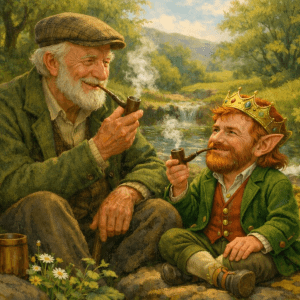
True to his word, King Brian never disappeared from my life. In fact, over the months and years that followed, he became a secret fixture of my days. Sometimes I’d catch a glimpse of him peeking from behind a turf stack or sitting cross-legged on a stone wall, puffing a tiny clay pipe with a sly grin on his face.
Other times, when grief or hunger weighed especially heavy on our cottage, I would hear a rap at the window late at night and find him perched on the sill, ready with a funny story or a homespun bit of fairy wisdom to lift our spirits.
As the worst of the famine eased (for even the darkest times eventually yield to dawn), our friendship only grew. By the time I was a wiry young man of eighteen, I had indeed shared that promised pint with King Brian. On my birthday, he marched right through our door at dusk—only Mam and I at home—and tipped his hat to my speechless mother.
I finally had to confess who my “special friend” was, a story which earned me quite the scolding at first. But Mam, bless her, came around fast—especially after Brian produced a thimbleful of fine poteen from his waistcoat pocket as a gift.
We drank by the hearth—me with a full mug of ale, King Brian with his tiny thimble—and Mam even managed a sip. That evening was the first time I heard her laugh since before Nuala’s death. It rang sweet and free in our little cottage, and I silently thanked every saint and fairy that I’d made the choice I did.
Over the years, King Brian’s visits became a cherished routine. When I took on a small plot of land to farm, he’d sometimes appear at twilight, offering unsolicited (and often humorous) farming advice—”Talk to the cows kindly and they’ll give sweeter milk, Seamus me lad”—or just keeping me company as I mended a fence. If I went fishing by the rocks and my line came up empty, more than once I’d hear a splash and see him winking from a tide pool, soon followed by a sudden tug on my line and a plump fish on the hook that hadn’t been there a moment before.
He never showered me with material riches (we’d agreed, after all, no gold), but in a hundred small ways he ensured we never fell into despair. A basket of mushrooms or wild berries would turn up mysteriously on our step during lean weeks. When Mam fell ill one winter, a strange bundle of herbs appeared on the mantel, and an old recipe he recommended helped bring her fever down.
I grew older; I married a local girl, Eileen, whose smile was brighter to me than any coin. King Brian danced a jig in celebration at our quiet wedding (visible only to me, which caused some raised eyebrows when I spun an “invisible partner” around the floor). He became an unseen godfather to our children, leaving little wooden toys for them at Christmas and making sure their porridge pot was never truly empty.
The pot of gold that I once craved so dearly would indeed have been spent and gone by then, its memory likely faded or bittersweet. But the bond I forged with Brian—now that was a treasure no time could tarnish.
It’s been many decades since that day by the brook, and I’m an old man now, grey as a rain cloud. Yet King Brian still visits. We sit by the fire at the local pub or at my hearth, two old friends sharing stories of days long past. Sometimes we fall into comfortable silence, just enjoying the warmth and the fact that neither of us is alone.
Looking back, I know in my soul that I chose rightly. Legacy isn’t measured in gold coins; it’s measured in the lives we touch and the friends we keep. Love and loyalty outshine gold every time.
I’ve outlived many of my human friends, but Brian—well, he’ll be with me till I go to my grave, and I suspect even then I won’t be rid of his company. Perhaps he’ll carry my stories and my memory, the way only a true friend can.
Before I finish my tale, I have a word of advice for you, dear reader (or dear grandchild, should one of mine be reading this aloud). If ever you find yourself wandering near that babbling brook on Arranmore with dreams of fortune in your head, and you happen to spot a wee little man in a fine green coat, with a barley-colored beard and merry eyes—perhaps humming a tune on a sunny afternoon—do an old man a favor.
Smile and give him a polite hello. Tip your cap and address him as King Brian (for that is sure to be him). But whatever you do, don’t go pouncing upon his bones trying to snatch him up. You’d only rumple his coat and annoy him greatly. Instead, maybe sit with him a spell. Share a joke or a story. Become a friend to that good wee king, as I did, and leave his pot of gold alone.
Trust me: the treasure you’ll gain is worth more than all the gold in Ireland.
Author’s Note:
Thank you for reading the conclusion of Pot O’ Gold. This story has lived with me for more than two decades, and finishing it has been a joy. I hope Seamus and King Brian linger with you the way they’ve lingered with me.
A wee tale of gold and friendship seems the perfect way to close out March. But next time, I’m stepping out of the mists of Arranmore and into a memory from my own childhood — a story about a comic book, a mailman, and the very first thing I ever tried to order through the mail. Spoiler: it wasn’t gold… but it was just as magical to a three‑year‑old.
If you enjoyed Seamus and King Brian’s journey, feel free to pass my blog along to a friend, neighbor, or wandering leprechaun. Stories travel best when carried from one heart to another.
 The Boyle Blogs
Leave a comment