Author’s Note:
Two weeks ago I shared the poem, Pot O’ Gold, written years ago and recently expanded into a full short story. Today, on St. Patrick’s Day, I’m sharing Part One of that story — a tale set on Arranmore Island in 1847, during the darkest days of the Great Hunger. This first part follows young Seamus O’Donnell as he sets out in desperation to find the Leprechaun King his grandmother once told him about. What he discovers will change everything.
Pot O’ Gold — Part One: The Boy Who Caught a King
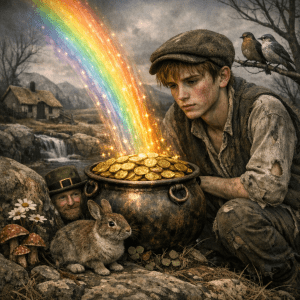
They say the King of the Leprechauns keeps a pot of gold hidden somewhere close. On Árainn Mhór—Arranmore Island—such whispers traveled in famine days like wisps of peat smoke through a starving village. I grew up hearing them from my grandmother as she rocked by our hearth, her voice low and quavering: “If ye catch the Leprechaun King, he’ll grant ye your heart’s desire—be it his gold or three magic wishes.” At ten years old, hollow-cheeked and weary, I half-believed those tales were as nourishing as a warm bowl of porridge.
In the bleak year of 1847, stories were sometimes all we had. The Great Hunger had settled on our island like a curse. Our potatoes turned black in the ground; the oats and barley we reaped were hauled off to English markets under armed guard. Families withered to shadows of themselves. I had seen neighbors collapse in the road, and children’s ribs counted by the landlord’s agent as if we were livestock. My own little sister, Nuala, lay buried under a stone so small it barely held the first letter of her name. I was not yet a man, but already I carried a weight of grief and hunger that bent my back.
Still, there was a spark in me that refused to die. Perhaps it was my grandmother’s whispered legends of fairies and heroes. Perhaps it was simple desperation. All I know is that one bright midday, with the sun glaring down on our blighted fields, I decided to set out in search of a miracle. Or at least, in search of that fabled pot of gold.
“Seamus, where are ye off to?” my mother croaked as I slung a fraying satchel over my shoulder. She was a wisp of herself on the doorstep of our stone cottage, cheeks sunken but eyes sharp with worry.
“Just for a walk, Mam,” I answered, trying to sound cheerful. I didn’t dare speak of Leprechauns or gold. Hunger and sorrow had hardened her, perhaps even more than me; she had no patience for pishogues—the old superstitions. But she didn’t stop me. She only tucked a scapular into my hand—a small cloth holy charm—and closed my fingers around it. “For safety,” she whispered, as if sensing that I sought something beyond a simple stroll.
I gave her a quick hug, feeling the brittle ridge of her spine through her shawl. Then I turned and headed up the lane.
The path out of our village was little more than two wheel-ruts winding past barren potato plots and turf bogs. The late winter frost had gone, leaving the ground raw. With each step away from home, I felt a strange lightness, as though hope itself lifted my feet. The King of the Leprechauns has a pot o’ gold, I murmured to myself, recalling Gran’s words. ’Tis so, for sure, some say. Could it be true? Could there really be a hidden treasure that might save us?
The thought was a flame warming my mind. I imagined returning to Mam with a sack of gold coins heavy as a newborn lamb. We could buy food—if any was left to buy—or book passage on a ship to America like some of our neighbors had done. We could pay the rent we owed so the Marquess’s agent wouldn’t turn us out. Perhaps we could even help others on the island. The possibilities swirled, bright and dizzying, as I walked on.
I climbed over the stony ridge that sheltered our cluster of cottages from the Atlantic winds. Below me lay Arranmore’s wild expanse: heather and gorse spread in a brown-and-purple patchwork, bog pools glinting under a hazy sun. Farther off, cliffs fell to a restless slate-grey sea. Gulls wheeled and cried, but otherwise an eerie midday hush lay over everything. No turf smoke rose from the chimneys behind me—fuel was scarce. No voices called out across fields. Many were too weak for talk, saving their breath for prayers and laments.
As I descended the far side of the hill, I left the view of the village behind. A narrow lane, lined with drystone walls fuzzy with moss, led me downward. This was a path rarely trodden now. It headed toward the island’s western bogs and a brook that once had been a favored spot for children to play. Nowadays, few children had the strength or spirit for play. But I followed that lane anyway, drawn by some instinct, or maybe by the whisper of a half-forgotten tune on the breeze.
Yes—halfway down the lane, I caught it: the faintest strain of music. I paused, heart thumping. It wasn’t the mournful fiddle or pipe that sometimes keened at a wake. This was a jaunty lilt, quick as a heartbeat, as if someone were whistling a jig to themselves.
I left the lane, following the sound across a stretch of spongy peat. My boots sank, sucking at the mud, but I pressed on toward a line of alder trees marking the brook. The tune grew clearer with each step. My mind raced: Could it be? For who would be whistling a merry tune in times like these?
The brook’s voice joined the melody—a burble of water running quick after spring rains. I crouched behind a stand of reeds, afraid to break the spell. There, on a flat stone by the water’s edge, sat a tiny man.
I nearly gasped aloud. He was no taller than a toddler, yet clearly not a child. He wore a fine green coat with tails, a waistcoat embroidered with odd symbols, and buckled boots that gleamed as if newly polished. His face was turned away as he gazed into the brook. But I glimpsed a pointed beard the color of autumn barley, and ears that tapered to subtle points. On his head perched a cocked hat with a sprig of white heather in its band.
My heart clamored against my ribs. I knew at once who—and what—this must be. Though I’d never seen a leprechaun before, nothing else he could be in his unnatural smallness and rich, old-fashioned garb. And not just any leprechaun, oh no. A snippet of Gran’s lore rushed back to me: The Leprechaun King is called Brian, a right trickster with power over all the fairy folk. King Brian of the Leprechauns… if anyone had a pot of gold, it would be him.
Sunlight poured down through the alder branches, gilding the brook in ribbons of gold. The king—for who else would sit so confidently out in the open?—dipped a tiny tin cup into the water and sipped. Then he sighed contentedly and began to hum another tune, swinging his dangling feet. He hadn’t spotted me at all.
I realized I was holding my breath. The wind had died entirely; the reeds stood still around me. It felt as if the very island was watching, waiting to see what I’d do.
My mind tussled with itself. One part urged caution: every story of leprechauns warns how cunning they are, how quick to vanish if they even sense a human’s presence. Another part of me, the desperate and hungry part, whispered: This is your chance—maybe your only chance—to save everything. I pictured again my mother’s gaunt face, my father’s grave on the hill, the neighbors leaning like thin ghosts against their doorframes. One pot of gold could change it all.
I steeled myself. I clenched Gran’s scapular in my fist for luck and protection. Then I quietly set my satchel down and crept forward on all fours through the reeds.
The little king was still humming, now peering into the brook as if looking for fish or maybe admiring his reflection. His back was to me. Twenty paces… ten… I could see the fine weave of his coat now, and the way his pointy ears twitched in time with the tune. My heart was drumming a war march. I thought even he must hear it, but if he did, he gave no sign.
I was right behind him now, crouched low, scarcely daring to breathe. He smelled of peat smoke and wildflowers, an oddly comforting scent. My hands trembled, poised to snatch. In one of Gran’s stories, a leprechaun had escaped because the farmer who caught him looked away for the briefest blink. I fixed my eyes on King Brian, determined not to lose him now that fate had put him within my reach.
“If I be the lad to snatch him up,” I mouthed soundlessly, echoing a line from one of Gran’s rhymes, “his pot o’ gold be mine.” My lips were dry. I wetted them, counted silently: one, two… and on three, I lunged forward and grabbed the tiny man around his waist.
Pandemonium broke the silence.
I clamped my arms around the little man with all the strength my scrawny limbs could muster. He was surprisingly solid—like grabbing a struggling cat or a stout log that wriggled.
“Aaaagh!” he yelped—a sound more astonished than pained. He bucked and twisted, nearly slipping free, but I cinched my grip tighter around his middle. His boots kicked wildly, catching nothing but air. The serene brookside exploded into splashes and shouts as he fought to get loose.
For a moment I feared he’d vanish or slip through my fingers like a wet trout. Gran’s stories rushed through my head: Keep your eyes on him, never look away. I gritted my teeth and hung on, even as he squirmed.
“Unhand me, ye great galloot!” the tiny fellow screeched. He spoke in a high, reedy voice laced with indignation. “What d’ye think ye’re doing, grabbing honest folk from behind? Let me go, ye clod!”
Honest folk, indeed! I only tightened my hold, lifting him off the ground. He was lighter than a sack of turf, but he thrashed twice as hard. “I’ll not let ye go,” I panted. “Not until—”
Suddenly he went still. Not limp—he was tense as a coiled spring—but he ceased his wild flailing. “Not until what?” he asked sharply.
I held him facing outward, his boots dangling a foot above the ground. The little man craned his neck to glare up at me. His face was as weathered and keen as an old fox’s: bright hazel eyes, a sharp nose, and a beard that jutted like a reddish spade. Those eyes bored into mine, full of furious intelligence.
Our gazes locked. For an instant, I felt a jolt in my chest—like the kick of a mule—when those eyes met mine. It nearly made me loosen my arms, but I dug my fingers into my own wrist to keep firm.
He drew himself up as best he could while pinned. “Do ye know who I am, boy?” he demanded, voice quavering with outrage.
“I might,” I managed, breathless. “And if you are who I think, you know well why I caught ye.”
At that, his eyes narrowed cunningly. “Oh, do I now? Perhaps ye could enlighten me.” He tried to sound calm, but I could hear the tremor beneath. Perhaps even Leprechaun kings can feel fear.
“I’ve caught the King of the Leprechauns, if I’m not mistaken,” I said, my voice trembling with excitement. “And everyone knows if you catch a leprechaun—especially a king—he must give ye a grand reward.”
The wee fellow’s eyebrows shot up, then his expression split into a broad grin, crinkling the corners of his eyes. To my surprise, he let out a hearty chuckle. “Hah! Clever lad. Ye’ve a quick wit to go with yer quick hands, I’ll grant ye that.”
With a sudden, courtly flourish utterly at odds with his predicament, he swept off his tricorn hat and gave a little bow as much as my arms allowed. “Since ye already seem to ken it: I am King Brian of the Leprechauns, at yer service.” He spoke grandly now, as if we were meeting at a country dance and not like this—him dangling like a rabbit caught by a snare. “And what might I call you, bold captor?”
“Seamus O’Donnell,” I answered automatically, then bit my tongue. Gran had warned—never give the Fair Folk your full name too freely, for names hold power. But it was done.
King Brian’s grin grew wider, showing a set of small, very white teeth. “Well then, Master Seamus O’Donnell, since ye’ve laid hands on me, custom does indeed say I owe ye something. Usually a wee pot of gold, eh?” He winked, as if we shared a joke.
My heart jumped at the mention of gold, but I tried to play it cool. “Aye, that’s the usual tale,” I said warily. He was being unexpectedly jovial—too jovial, perhaps. Leprechauns are tricksters, Gran always said.
He cleared his throat dramatically. “But times being what they are,” he went on, “maybe ye’d prefer something else. Gold’s not much use if there’s no food in the market to buy, now is it?”
I stiffened. Had he read my thoughts? Or was it simply obvious from my gaunt face what I was after? I remained silent, not trusting myself to parley cleverly.
King Brian shifted in my grasp; I let him turn to face me, though I still held him firmly around the waist. He peered at me with sudden, intense gentleness. “Ye look half-starved, boy. And desperate, to be grabbing ahold of the likes of me. Tell me this—” and here his tone became silken and persuasive—”if I were to offer ye not just a pot of gold, but anything at all in the wide world, what would ye wish for?”
It was my turn to be taken aback. “Anything at all?”
“Anything,” he crooned. “By my royal word. Wealth beyond measure, food enough to fill all Arranmore’s bellies, health for your kin, strength for yourself, power to smite yer enemies—whatever yer heart desires. You have but to name it, lad, and I’ll grant ye three such wishes, if ye’d only do me the kindness of loosening these brute-like arms a mite.”
Three wishes. The promise made my head swim with wild possibilities—full bellies, strong arms, the landlord’s agent sent packing. For an instant I forgot myself, my grip loosening just a hair.
In that split second, King Brian braced his hands and shoved hard, nearly prying apart my hold. A jolt of alarm ran through me—I saw a gleam in his eye as he tensed to slip free. With a cry, I redoubled my grip, clasping him tight to my chest. The enticing visions vanished like smoke, and I was back beside the brook, heart hammering.
The king snarled in frustration, his pleasant mask dropping. “Saints alive, boy! Are ye trying to squeeze me in half?!” He wiggled, but I held fast.
“I know your tricks, Your Majesty,” I said through gritted teeth. “Ye’d have me loosen up and, quick as a wink, you’d disappear into a puff of smoke or a rabbit hole. I won’t fall for enchantments!”
He glared, but then the anger on his face melted into something like respect. “Clever and stubborn, I see. Fine then, keep yer hold if ye must, ye great lump of a lad.” He crossed his arms as best he could while pinned. “But me offer still stands. Wishes three, by the honor of King Brian, if ye’ll agree to release me after.”
I paused. Three wishes could indeed solve so much. Yet every tale I knew warned how fairy wishes often went awry—twisting your words and turning hope into disaster. I dared not risk some cursed irony hidden in a wish.
Better to demand something straightforward. I pictured again that simple pot of gold: tangible and unenchanted. We could use it carefully—buy what provisions were left, perhaps secure passage off this island. Gold might bring its own troubles, but those I understood.
My arms, still wrapped around King Brian, were trembling with exertion and nerves. He had gone quiet, watching my face closely. Finally, he spoke softly, almost purring: “I could give ye fame, lad. Ye could be celebrated as the savior of Arranmore. Or power, so no one could ever hurt ye or yours again. Or treasures far beyond a single pot. Why, think—ye could wish for ten pots of gold if ye liked.” His eyes glinted like twin coins in his weathered face.
I took a long breath, trying to steady my thudding heart. “I’m not wanting fame,” I said slowly. “And power… that often costs more than gold in the end, doesn’t it?” I recalled how those in power, like the English officers, seemed to lose their humanity. “As for ten pots of gold—one will serve my needs.”
King Brian tilted his head. “So, it’s gold ye want after all, eh? Just the one pot? That’s all?”
“It’s all I need,” I insisted. “Give me your pot of gold. That’s my wish. No tricks, no funny business. Just the gold, straight as you can.”
He regarded me for a moment in silence. A breeze picked up, making the alders whisper around us. A cloud drifted over the sun, painting the brook in shadow.
Then, abruptly, the king threw back his head and laughed. It was a rich, genuine laugh that rolled out of him and echoed off the brook’s banks. “By Dagda’s club, ye drive a hard bargain, Seamus O’Donnell!” he crowed. “Ignore the grand offers and stick to the plain request—oh, there’s many a grown man has failed that test where you stand firm.”
Test? I wondered, but he went on without explaining. “Right then, me lad. You’ll have your pot o’ gold, since that’s your heart’s desire. Unhand me now, and I shall conjure it for ye, quick and true.”
I almost released him in my excitement. But I caught myself. “With respect, Your Majesty, I’ll be keeping hold of ye until I see that gold with me own eyes.”
He gave me a baleful look. “Don’t trust me even a hair, do ye?”
I shook my head frankly. “Not a hair—not a whisker of that fine beard.”
He sighed, long-suffering. “Children these days. No manners,” he muttered. Then, in a louder, more formal tone, “Very well. If ye insist on this undignified arrangement, might we at least move from this bog? The gold’s not out here.”
I frowned. “Where is it, then?”
A sly twinkle lit his eye. “Why, where else would it be but safe at yer own home?” he said, as if it were obvious. “Tucked behind your cottage door, lad.”
My stomach flip-flopped. Behind my cottage door? Could it be? Our cottage was half a mile away at least. “You expect me to believe that?”
He sniffed. “I may be a trickster, but I’m no liar when it comes to a deal. You have my word—the pot o’ gold is at your home. If it’s not there, you can come back and drown me in this brook or whatever ye fancy. It will be there.”
I squinted, trying to discern any deceit in his face. But he looked almost… earnest. Still, I wasn’t about to risk him slipping away. “You’ll forgive me if I bring you along to verify, King Brian.”
He rolled his eyes dramatically. “Och, very well. I give ye what ye ask and still I’m treated like a common thief. Fine, fine. Hold me tight and carry me off, then. I’ll not resist.”
Suddenly, he stopped struggling altogether and went stiff as a board, making it easier for me to cart him. I wasn’t fooled by this docility, but I also wasn’t about to question it.
Gripping him firmly (though trying not to bruise him—I had a strange pang of guilt at manhandling a being who looked like a wizened old grandfather), I tucked the Leprechaun King under one arm. He was barely two feet tall, and though solid, not heavy.
“I’ll be watching ye close,” I warned.
“Aye, I gathered that,” he said dryly.
Thus I began the strangest walk of my life: carrying King Brian of the Leprechauns back to my own cottage to claim a treasure I had not yet seen, my heart filled with equal parts triumph and doubt. As I retraced the lane toward home, the world around us seemed to hold its breath in wonder.
The journey back felt like a dream. I trudged up the lane and over the hill with King Brian tucked under my arm like a mischievous doll. The sun veiled itself behind high clouds, and the air hung still and heavy. Neither of us spoke at first. The king seemed preoccupied—perhaps plotting some last trick—and I was too busy scanning for any sign of a double-cross.
My cottage came into view as we crested the ridge. It was a low whitewashed hut with a sagging thatch roof, crouched humbly against the hillside. A single curl of smoke rose from the chimney—Mam must have managed to light a bit of turf. I silently thanked God she was too frugal to leave a fire unattended; if she was inside, she’d be sitting by it. I hoped she might be napping, or at least wouldn’t come out just yet. How on earth would I explain the cargo under my arm?
As I neared our garden gate (little more than a gap in a stone wall), King Brian stirred. “Well, lad, here we are,” he quipped lightly. “Home sweet home. Shall we see if I’m a leprechaun of me word?”
I hesitated just outside the door. My heart was pounding again, perhaps harder than by the brook. If there was no pot inside, it meant he was tricking me after all—and I’d have to… what? Try to haul him back? But if the pot was there—real gold—then everything would change. The weight of that possibility made my hands slick with sweat.
I lowered King Brian to the ground, keeping a firm grip on his shoulder. Together we stood before the weathered wood of my cottage door. My throat was dry. “All right, let’s see,” I whispered, and lifted the latch.
The door swung inward with a creak. At first, I saw nothing unusual in the dim interior. The peat fire on the hearth was just a faint glow. The one-room cottage was shadowy, smelling of turf smoke and the broth of weeds Mam had boiled for lunch. I glanced quickly toward the corner where a curtain hung around Mam’s straw bed—no movement there; she must be resting.
Then my eyes adjusted, and I saw it.
There, just to the side of the threshold, as if casually placed out of the way, sat a black iron pot the size of a small bucket. I blinked, wondering if hunger was conjuring visions again. But no—the pot was real, its iron surface catching a glint of light from the hearth. And inside… inside I saw the unmistakable glow of coins. A heap of them, gold sovereigns by the look, tarnished but still gleaming softly.
A gasp escaped my throat. I dropped to my knees, hardly believing. It was exactly as the stories described—a pot of gold hidden by fairy magic. Only now it wasn’t hidden; it was here, in my home, within arm’s reach.
Behind me, King Brian gave a triumphant little laugh. “Go on, lad, have a peek. It’s all yours, fair and square.”
Hand trembling, I reached into the pot and picked up a coin. Even in the low light, it shone rich and warm. I had never held a gold coin before. It felt heavy in my palm—heavier than its size would suggest, as if it carried the weight of futures and dreams. Victoria’s profile was stamped on one side, a harp on the other. Real English sovereigns. Enough of these could buy a farm, a fleet of fishing boats, a passage to anywhere…
The king piped up softly, “Ye’d best count them later. Your poor eyes are about to pop out of yer head.”
I realized my mouth was open in astonishment. I let out a shaky laugh, feeling a bit foolish for my awe—but who could blame me? In all of Arranmore, perhaps no one had seen this much gold in living memory. The pot was near overflowing. There must be hundreds of coins. It could feed my family—and half the island—for many months, even at famine prices.
The relief and joy that surged in me were so intense I thought I might faint. We were saved. We were saved. I imagined rushing to wake Mam, pouring a pile of gleaming coins into her thin hands. I imagined the tears of joy that would fill her eyes. My own eyes prickled at the thought.
Behind me, King Brian cleared his throat pointedly. I realized I had, in my amazement, momentarily forgotten him. Quickly I stood and stepped back outside, pulling the door closed behind me to keep Mam from waking. King Brian stood with arms akimbo, watching me with a curious expression—half pride, half something else I couldn’t decipher.
“Ye see!” he said, sounding pleased. “I did not lie. A grand man o’ my word, am I not?”
I nodded vigorously. “Aye, you are that, Your Majesty. A grand… eh… leprechaun of your word, indeed.” My voice wavered with gratitude. Amidst all my suspicions, I hadn’t truly expected him to be honest. Some part of me had anticipated a trick—a pot full of leaves, a rainbow that vanished. But this was real.
King Brian gave a modest shrug. “Well then, our bargain’s done. You’ve got what ye wanted. And I—” He pointedly glanced at my hand, which still rested on his shoulder. I flushed and released him at once.
“Right, of course. I promised to let ye go,” I said hastily. I stepped back, offering a respectful half-bow. “You’re free to go, King Brian. Thank you—for keeping your promise.”
He tipped his hat in return, looking rather satisfied. “And thank you, Seamus, for not trying to wring my neck outright,” he said wryly. “That wouldn’t have ended well for either of us.” He straightened his emerald coat, brushed a speck of dust from it, and gave me one last appraising look. “Enjoy yer gold, lad. Spend it wisely, or foolishly—’tis yours now to do with as ye like.”
With that, he turned on his heel. I expected him to vanish in a puff of smoke or leap into thin air—something magical—but instead he simply began to stroll away down the lane, whistling as though out for an evening saunter.
I watched him go, a strange pang of something pricking through my elation. After all that had happened—the shock, the struggle, the triumph—was it to end so simply? Him off to wherever Leprechaun kings dwell, and me left with riches beyond measure? It felt… abrupt.
That’s when the future arrived.
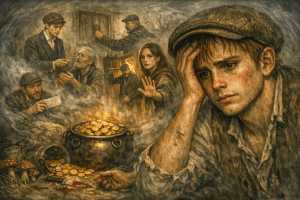
Not literally—call it a vision, call it a test, call it the island’s second sight rubbing raw. Maybe it was the king’s last prick of mischief; maybe it was my own fear made vivid. As I stood there with the sovereign’s bite still on my palm, the lane tilted and the air shimmered with heat that wasn’t there, and I saw it:
Me, in a suit bought with that gold, the cloth too stiff for my thin shoulders. Men crowding our door with the leak in their eyes that comes before the ask. “A loan, Seamus, just to Sunday.” “A bite for the children; sure you’ve plenty.” Envy wearing helpfulness like a borrowed coat.
Darker—word reaching the landlord’s agent that the O’Donnells had funds. A knock like a hammer. “Arrears settled, Mr. O’Donnell. And a raise due next quarter. You can pay.” And I did pay, because I had, and the pile shrank like wet turf.
A cousin I barely knew arriving with a ship’s ticket half-promised if only I’d stake him the other half. Mam proud and frightened at once. Eileen—(yes, Eileen, though I had not yet met her; something in that shimmer showed me the girl who’d be my wife)—Eileen standing in the lane, shoulders set, saying don’t open that door today; and me opening anyway because gold is a bell that summons everyone.
Then worse—a group with sticks and hunger, politeness gone to bone. Window smashed. The pot, half-empty on the floor. A fight, a shine of knife, blood that didn’t belong to anyone I meant to harm.
“Stop,” I said, and the yard snapped back: the wall, the furze, the king’s expectant face. I was breathing like I’d run the island’s stones in one go.
“Ah,” said King Brian softly, not smug now. “You saw it.”
Author’s Note:
Thank you for joining me for Part One of Pot O’ Gold. Seamus has found the treasure he thought would save everything — but the vision he’s just seen may change his heart in ways he never expected. Part Two of the story completes the tale and arrives on March 31, and I hope you’ll return to see how his choice shapes the rest of his life.
Make sure to tell your friends of Seamus O’Donnell’s exploits and share the blog site, “theboyleblogs” with them.
 The Boyle Blogs
Leave a comment