Grown-Up Ghosts, & Childhood Echoes
Author’s Note: Not every story makes it into the first telling. Some slip between the cracks of memory, or stay hidden in notebooks and desk drawers for years, waiting for their turn. These are what I call the Lost Chapters.
They didn’t make it into the main body of my most recent book, You Can’t Get Blisters—sometimes because they were too raw, sometimes because they arrived late in the game, and sometimes because I plain forgot where I’d written them down. (When you’ve been scribbling for forty years, things hide out in places stranger than the attic.)
February’s stories sit on opposite ends of the emotional spectrum. One is a quiet, haunting moment that woke me before dawn and never quite let go. The other is a childhood memory of ice, kindness, and a nosebleed that could’ve been classified as a natural disaster. Both are true. Both shaped me. And both deserve their place on the page.
This first story isn’t fiction, it occurred over twenty-five years ago. At 4:51 a.m. one morning, I heard my daughter’s voice as clearly as if she were standing in the room. She was asleep in California. I was wide awake in Wisconsin. That moment changed something in me. I never spoke about it—not then, not after—but it stayed with me in a way I can’t quite explain. There are still times, in the hush between heartbeats, when I hear her voice again. Writing this piece is my way of not forgetting.
I may have written the story in the third person, but the experience is mine, and it’s stayed with me ever since.

“Hi Daddy.”
Startled, he woke up. Glancing at the clock radio on his side of the bed, he read 4:51. He scanned the dark bedroom, looking for his daughter. No one was in the room except his wife, snoring loudly beside him.
He knew he wasn’t having a dream; this was real. But how could it be? His daughter, Renee, was living in California. He was living in Wisconsin.
He couldn’t get back to sleep. Tossing and turning, he worried. Was it a dream? Was it real? Nervously, he slid out of bed and, so as not to wake his wife, went into the spare bathroom to take a shower. The hot, prickly water hitting his head couldn’t wash away the haunting sound of “Hi Daddy.”
Returning to the bedroom, he stepped silently into the walk‑in closet and shut the door. He picked out his clothes for the day—black pants and a black pullover sweater. The clothes matched his mood.
After dressing, he turned out the closet light and walked to his nightstand for the stockings in the bottom drawer. He grabbed his shoes, lying nearby.
With shoes and stockings in hand, he stepped out of the bedroom and headed down the stairs. All the while, the strange words “Hi Daddy” pounded in his head.
Walking down the steps, he wondered whether he should call his daughter in California. Minutes slid past like ice down a glass until the living‑room Regulator clock chimed 5:32. Much too early. He was on Central Standard Time; she was on Pacific. It was only 3:32 a.m. in California.
He told himself she was sleeping soundly, blissfully unaware of the moment that had jolted him awake.
So he brewed a pot of coffee, unfolded the morning paper, and tried to settle his nerves. His wife wouldn’t be up for another forty‑five minutes. He decided he wouldn’t mention it to her—he didn’t want to worry her with something he couldn’t explain himself.
In truth, he never mentioned it to anyone.
Post Script: Years later, she moved to Wisconsin. He moved to California. He never spoke of that night—not then, not after. But every so often, in the thin quiet before dawn, he still hears it. Soft. Tender. And unmistakably awake.
Author’s Note: Some stories cling to you for a lifetime, and this next story has been hanging on since 1st grade — probably because it involved snow, heroism, and a nose that briefly tried to relocate itself. Before sharing it here, I reached out to the classmate who rescued me that day and dragged me (literally) to safety. She and her mother showed me more kindness than any kid with a face full of blood had a right to expect. This story is my way of honoring that moment — and the people who helped turn a painful memory into one I can smile about seventy years later.
The Bloody Nose Incident
Or: No Good Deed Goes Unpunched
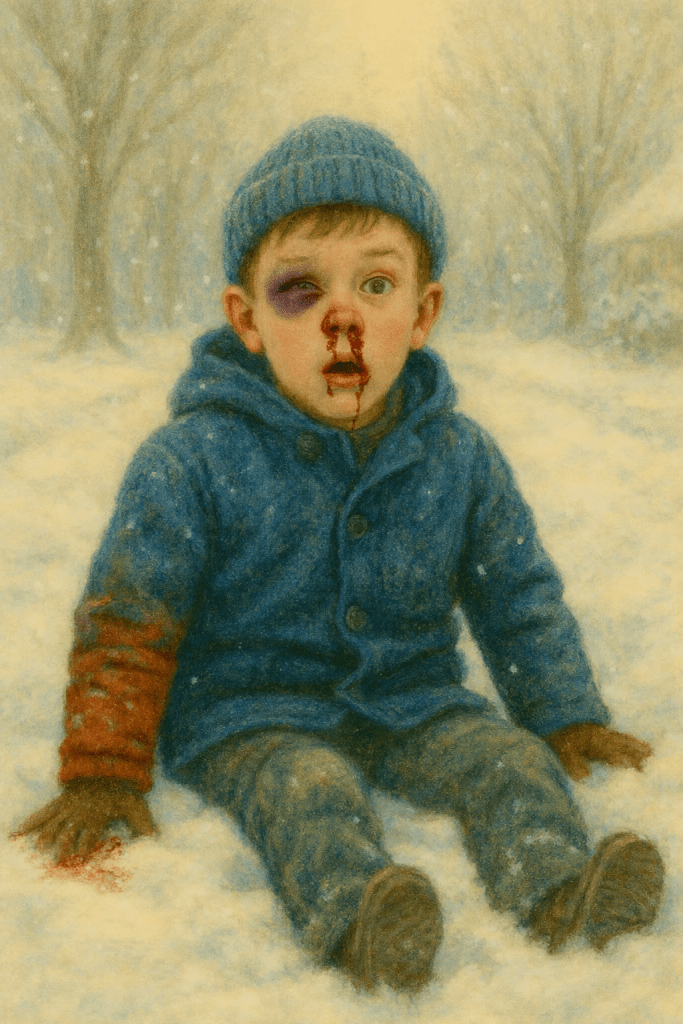
I was only in second grade when I discovered that heroism can sometimes leave your mug looking like modern art. It happened on a bone-chilling midwinter afternoon in Superior, Wisconsin—where the fire department’s freshly flooded outdoor rink gleamed like a giant mirror. We had skates, scraped knees, and grand dreams of gliding into glory.
As I trudged home past that perfect ice, I spotted a fourth-grader barging through the slush like an out-of-control moose. With every soggy stomp, he gouged deep craters destined to snap innocent ankles come skating season. In my mind’s eye, weekend skaters were already sailing head-over-heels like bowling pins.
Naturally, I had to intervene. I puffed out my chest (in galoshes, no less) and hollered, “Hey! Stop wrecking the ice—people skate here!” Then, summoning every ounce of childhood bravado, I warned, “If you don’t quit, I’ll find someone who’ll make you stop!” Much to my relief, he slunk away, and the rink survived—mostly intact. I went home a hero…or so I thought.
Fast forward three months to the thawing days before Easter. The snow had melted into crusty gray slush, and jellybeans danced in my head. That’s when “delayed karma” caught up with me. Without warning, I felt a tackle from behind and found myself smacked with fists and feet in a flurry of vengeance. My assailant snarled something about teaching me a lesson for daring to boss him around. Then he vanished, leaving me sprawled on the sidewalk, stunned and bleeding like a busted fire hydrant.
Enter Patty, my second-grade guardian angel. She dragged me to her house, where her mother, Mrs. Wasserman, transformed from kindly neighbor to emergency room triage nurse in two heartbeats. No questions—just a washcloth and elbow grease. She scrubbed, rinsed, and repeated until the kitchen sink looked like Dracula’s day spa. Between every swirl of red water, I realized this was no ordinary nosebleed; my face had declared war on my skull.
Eventually, the bleeding slowed, my clothes straightened, and I looked less like a Jackson Pollock painting and more like…well, a kid with a story. Weeks later, I learned it was that same ice-wrecking fourth grader who’d spent the winter plotting my downfall. Rumor had it he was now under a shrink’s care—thankfully licensed to hammer little boys at his leisure, but hopefully without a private rink in his backyard.
Moral of the Story Stand up for what’s right, and you might earn a bloody nose. But keep your chin up—sometimes, that nose becomes the punch line of a great story for the next seventy years.
Author’s Note: If you enjoyed these Lost Chapters, feel free to share them with friends, neighbors, relatives, and even the folks who pretend not to like you. The more readers who wander into The Boyle Blogs, the more stories I get to pull out of the attic. Thanks for being here — and for spreading the word.
 The Boyle Blogs
Leave a comment